Home / Epoxy Mixing Nozzles / Static Mixing Nozzles
Static Mixing Nozzles for 2-Part Adhesive Dispensing

Static Mixing Nozzles for 2-Part Adhesive Dispensing

Disposable Static Mixer Nozzles for Dual Cartridge and Industrial Adhesive Dispensing Systems
Btektech supplies disposable static mixing nozzles for epoxy, polyurethane, silicone, acrylic and other two-component adhesives. Our static mixer nozzles are available for 50ml-1500ml and larger dual-cartridge systems, with multiple inlet styles, element counts, lengths and outlet options for industrial dispensing applications.
Get a Quick Quote

Key Advantages of Static Mixing Nozzles

Static mixers provide one-time use, helps reduce cure inconsistency, and keep the mixing path stable in industrial applications.
  • Stable Mixing Path: Fixed internal elements split and recombine material streams before discharge, which helps reduce visible streaks and uneven cure.
  • Disposable Changeover: Single-use mixers help reduce cross-contamination risk between batches and minimize cleanup during material changes.
  • Flexible Configuration Range: Multiple element geometries, lengths, outlet styles, and interfaces help match viscosity, shot size, and cartridge format.
  • Cartridge & Gun Compatibility: Multiple inlet and outlet options help match different dual-cartridge dispensing systems and application requirements.
Request For Our Latest Price

Static Mixing Nozzles Configurations

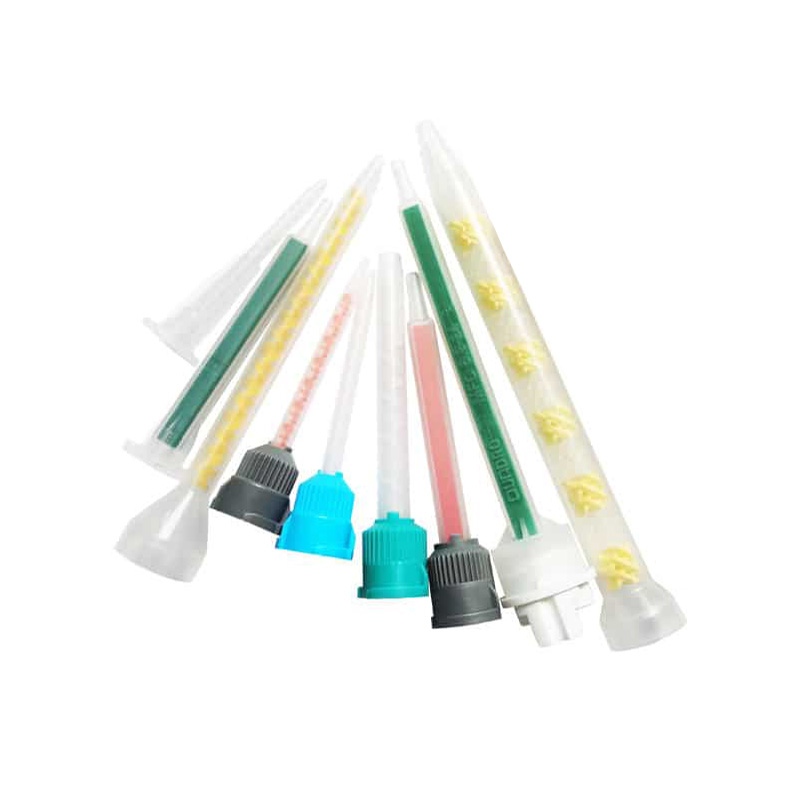
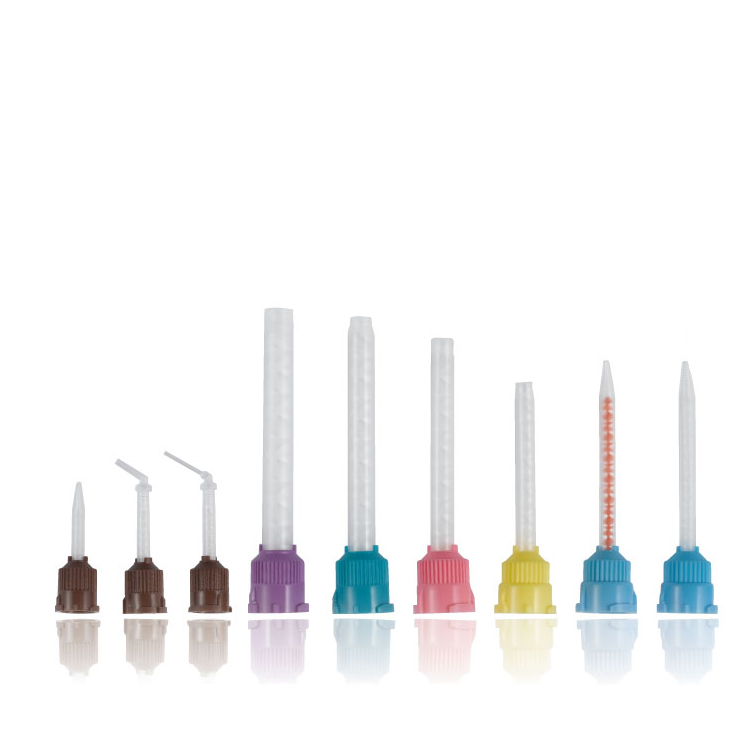
As a professional manufacturer of dispensing equipment, Btektech offers static mixing nozzles matching different dispensing setups. Bayonet and bell-mouth inlets fit different cartridge families, while helical, square, and cross-grid mixing paths support different needs in flow continuity, retained volume, pressure drop, and material handling. Housing materials include polyacetal(POM) and PP housing to suit different chemical compatibility and rigidity requirements. Element counts range from 7 to 48 elements, and inner diameter options span 3 mm to 19.9 mm to accommodate different material viscosities and flow volumes. Outlet configurations include standard tapered tips, stepped discharge outlet, and luer lock tips for applications requiring needle attachment or fine-tip dispensing.

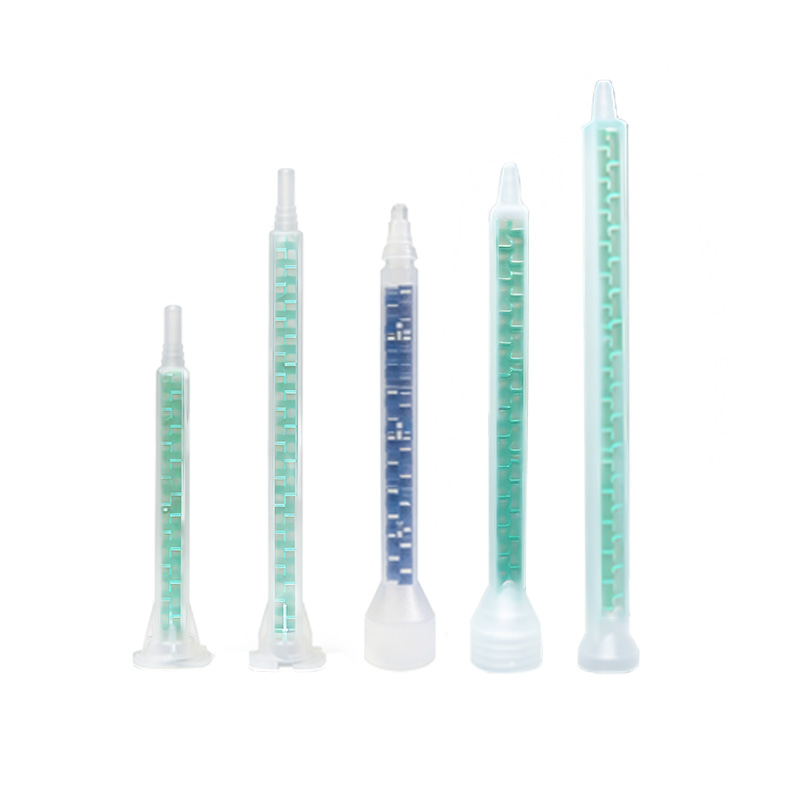
Bell Static Mixer Nozzle

Bell Static Mixer Nozzle

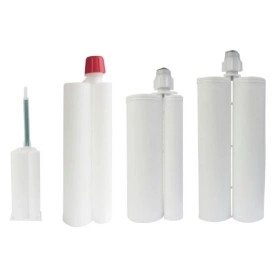
Bell static mixer nozzles are commonly used with 200ml, 400ml and larger dual-cartridge systems. The bell-mouth inlet helps support higher material volume and stable adhesive flow into the mixer body.

View Bell Static Mixer Nozzle
Bayonet Mixer Nozzle

Bayonet Mixer Nozzle

Bayonet static mixing nozzles are designed for 50ml dual cartridges with quick twist-lock connection. They are commonly used for 1:1, 2:1 and 4:1 epoxy, PU and silicone adhesive dispensing.

View Bayonet Mixer Nozzle
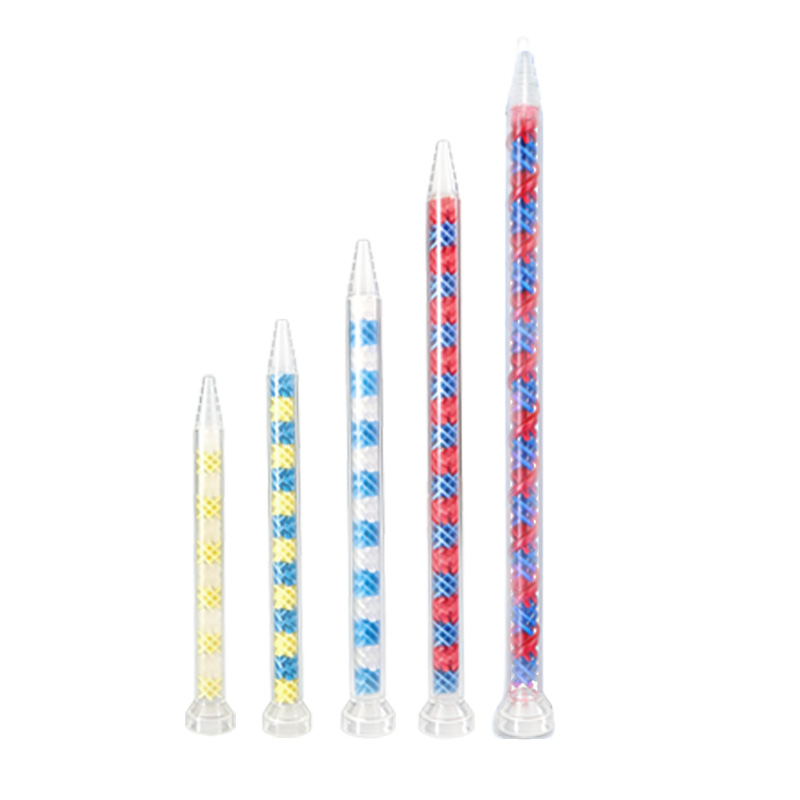
Cross-Grid Mixing Nozzle

Cross-Grid Mixing Nozzle

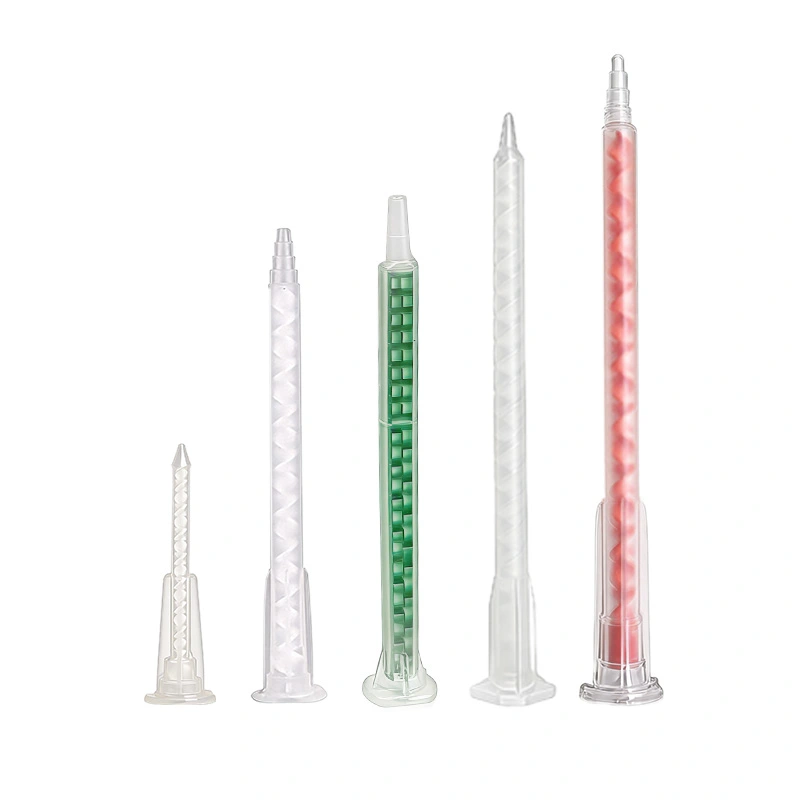
Cross-grid static mixing nozzles split and redirect two-component materials through an X-shaped element path, helping achieve stable mixing with lower retained volume in selected adhesive applications.

View Cross-Grid Mixing Nozzle
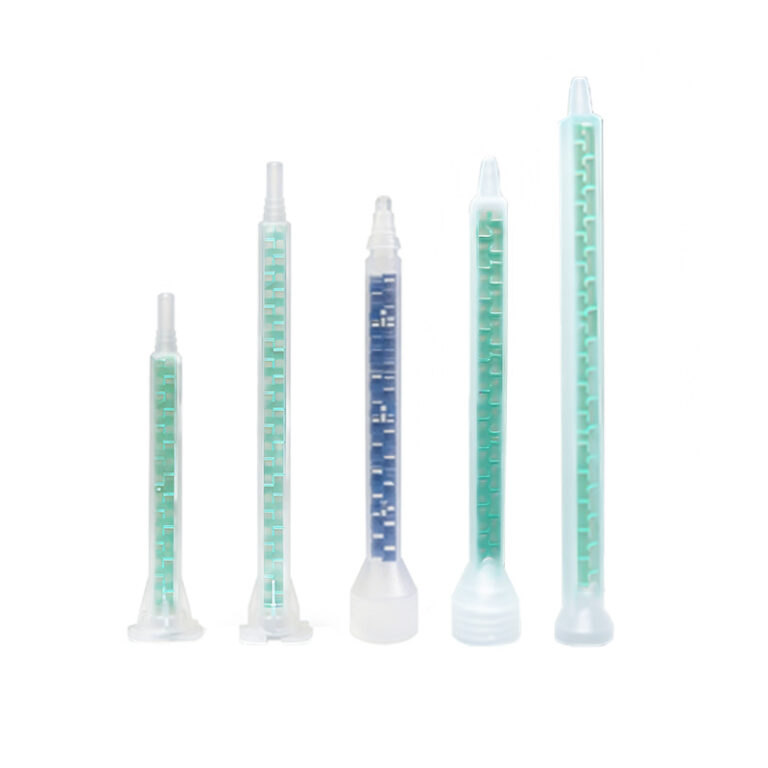
Square Mixing Nozzle

Square Mixing Nozzle

Square static mixer nozzles provide compact mixing with reduced retained adhesive volume. They are suitable for applications requiring shorter mixer bodies and controlled material waste.

View Square Mixing Nozzle
No. Part No. Elements I.D.(mm) L(mm) O.D.(mm) A(mm) Inner-core Color
A1 PMC3.0-08S 8 3 38 4.6 1 White
A2 PMA3.0-07S 7 3 33.2 4.6 1 White
A3 PMA3.0-17S 17 3 63 4.6 1 White
A7 PMA6.3-21S 21 6.3 153 8.7 1.5 White
A8 PMA6.3-21L 21 6.3 151.5 8.7 1.5 White
A9 PMA6.3-12S 12 6.3 97 8.7 1.5 White
A10 PMA3.0-13S 13 3 50.6 4.6 1 White
A11 PMA4.0-13S 13 4 66 2.5 2 White
A12 PMA4.0-17S 17 4 81.6 5.8 2 White
A13 PMA5.4-07S 7 5.4 55.7 7 1.5 White
A14 PMA5.4-13S 13 5.4 84.6 7 1.5 White
A15 PMA5.4-21S 21 5.4 124 7.6 1.5 White
A16 PMA6.3-17S 17 6.3 128 8.7 1.5 White
A21 PMX5.4-17S 17 5.4 103.7 7.6 1.5 Red
B5 PMC05-18 18 5 120 8 1.5 White/Yellow/Blue
B6 PMC05-24 24 5 149 8 1.5 White/Yellow/Blue
B7 PMS05-32 32 5 188 8 1.5 White/Yellow/Blue
B8 PMC06-18 18 6.3 148 10 1.9 White
B9 PMC06-24L 24 6.3 185 10 2 White
B10 PMS06-32 32 6.3 234 10 1.9 White/Yellow
B11 PMC08-18 18 8 175 12 2.4 White
B12 PMC08-24 24 8 223 12 2.4 White/Yellow/Blue
B13 PMC08-32 32 8 287 12 2.4 White/Yellow/Blue
B14 PMC10-12 12 10 156 14 3 White
B15 PMC10-18 18 10 215 14 3 White
B16 PMC10-24 24 10 276 14 3 White/Yellow
B17 PMS10-32 32 10 352 14 3 White/Yellow /Blue
B18 PMS13-18 18 13 223 17 4 White
B19 PMS13-24 24 13 293 17 4 White/Yellow
B20 PMS13-32 32 13 379 17 4 White/Yellow
B21 PMS13-36 36 13 423 17 4 White/Yellow
B22 PMC09-24 24 9 231 12.7 3 White
B23 PMS06-48 48 6.3 333.8 9.4 2 White
B24 PMS09-40 40 9.3 359 13 3 White
B25 PMC04-24 24 4.7 131.72 7.6 1.78 White
B26 PMC12-12 12 12.65 170.4 16.76 4 Yellow
B27 PMC13-12 12 13 197 17 4 White/Yellow
A4 PMF6.0-16 16 5.3 83 7.5 1.8 Green/ Gold/pink/white
A6 PMF6.0-24 24 5.3 115 7.5 1.8 Green
B1 PMF06-24 24 5.3 127 7.5 1.8 Green
B2 PMF08-24 24 8.7 150 12 3.5 Green
B3 PMF08-24T 24 8.7 165 12 3.5 Green
B4 PMF08-32 32 8.7 188 12 3.5 Green
B65 MBQ08-18 18 8.7 143 12 3.5 Blue
G1 GSM9-12 12 9.3 146 12.5 3 White/Yellow
G2 GSM9-14 14 9.3 164 12.5 3 Blue/Yellow
G3 GSM9-16 16 9.3 183 12.5 3 White/Blue
G4 GSM9-20 20 9.3 220 12.5 3 Blue/Red


Cartridge and Dispensing Gun Compatibility

System Type Common Cartridge Size Recommended Nozzle Type Typical Use
Manual dual cartridge gun 50ml Bayonet static mixing nozzle Small-volume epoxy dispensing
Pneumatic dispensing gun 200ml / 400ml Bell static mixer nozzle Industrial bonding and sealing
Semi-automatic dispenser 400ml / 600ml Bell or cross-grid mixer nozzle Repeatable production dispensing
Precision dispensing system Syringe / small cartridge Luer lock or stepped outlet nozzle Fine bead or needle dispensing

How to Choose Static Mixing Nozzles

Selection Factor What to Check Recommendation
Adhesive viscosity Low, medium or high viscosity Higher-viscosity materials may require larger inner diameter, suitable element design or longer mixing path
Cartridge size 50ml, 200ml, 400ml or larger cartridge 50ml cartridges often use bayonet nozzles; larger systems often use bell-mouth nozzles
Mixing ratio 1:1, 2:1, 4:1, 10:1 Choose a nozzle compatible with the cartridge outlet and required mixing ratio
Element count Number of internal mixing elements Higher element counts improve mixing but may increase pressure drop and retained volume
Outlet type Tapered, stepped, luer lock or needle attachment Select outlet style based on bead size, tip compatibility and dispensing precision

Customization Options for Static Mixing Nozzles

Standard static mixing tubes may fail to meet your demands. Customization makes them integrate with your dispensing tools, materials, and branding requirements.

OEM Build

OEM Build

Adjust element geometry, mixer length, inner diameter, outlet shape or housing material based on your adhesive viscosity, flow rate and dispensing process.

ODM Layout

ODM Layout

Develop nozzle structures for specific cartridge formats, dispensing equipment layouts or special application requirements.

Interface & Integration

Interface & Integration

Customize inlet style, outlet tip shape, mixer length, internal diameter and color coding to match your dispensing tools and adhesive system.

Private Label Options

Private Label Options

Support custom colors, engraved logos, private-label packaging and bulk supply for adhesive brands, distributors and dispensing equipment companies.

Excellent Performance in Industrial Applications

Static mixing nozzles are widely used in industrial adhesive dispensing applications, including automotive bonding, electronics potting, composite repair, construction anchoring and general assembly. They are especially suitable for cartridge-based two-component adhesive systems.

Static Mixing Nozzles in Automotive and Transportation

Automotive Manufacturing & Structural Bonding

Static mixing nozzles are widely used in automotive manufacturing for windshield bonding, structural bonding, seam sealing, battery module assembly and gap filling. They help dispense two-component adhesives with consistent mixing and stable output, improving application reliability for safety-related components.

Send Inquiry Now
Static Mixing Nozzles in Electronics Manufacturing

Electronics Potting & Electrical Assembly Protection

For electronics manufacturing, static mixing nozzles are used for resin dispensing, electronic potting, encapsulation, thermal interface materials, battery modules and electrical housings. They support precise bead control and accurate dispensing volume to help protect sensitive electronic assemblies.

Send Inquiry Now
Static Mixing Nozzles in Emerging Industry

Composite Repair, Construction & Anchoring Adhesives

Static mixing tubes are suitable for composite bonding, laminate repair, panel assembly, portable field dispensing, chemical anchoring, crack repair, doweling and structural fixing. Different element geometries and nozzle lengths can be selected based on material flow rate, working time and bead control requirements.

Send Inquiry Now

Frequently Asked Questions About Static Mixing Nozzles

What materials can be used with a static mixing tube?

Static mixing tubes are commonly used for epoxies, silicones, polyurethanes, acrylics, and other two-component materials. Material viscosity, filler content, and curing speed can all influence dispensing performance.

What types of cartridges can your static mixer nozzle be used with?

+

Why are disposable static mixer widely used?

+

Which static mixing nozzle fits 50ml dual cartridges?

+

What are the advantages of static mixing in industrial applications?

+

Can static mixing nozzles be used for 1:1, 2:1 and 4:1 ratios?

+

What is the difference between bayonet and bell static mixer nozzles?

+

What is the difference between square and helical static mixer nozzles?

+

Are static mixing nozzles disposable?

+

What information should I provide for a nozzle recommendation?

+

Learn More About Static Mixing Nozzles

Our blog is designed to help you deepen your knowledge of fluid dispensing processes, optimize your production line, and select the best components for your specific challenges. Explore articles that connect industry insights with practical solutions.

View Related Blog →