
Introduction
If your caulk gun is hard to squeeze, not dispensing material, releasing unevenly, or getting stuck during use, the problem is usually linked to a small number of mechanical or setup issues. This troubleshooting guide is organized by symptom so you can quickly find the likely cause and jump to the most relevant fix. Use the list below to identify the problem first, then go directly to the matching solution.
Hard to Press the Trigger
Why it happens: The gun’s thrust ratio isn’t strong enough for the material being dispensed, or the cartridge isn’t seated flush against the gun’s back plate.
Quick fix: Reseat the cartridge first to rule out positioning. If resistance continues, switch to a caulk gun with a higher thrust ratio rated for your adhesive’s viscosity.
How to Prevent: Before loading a new cartridge, check the adhesive manufacturer’s datasheet for recommended application pressure and confirm your gun’s thrust ratio meets that requirement. Always press the cartridge firmly against the back plate until it clicks into position before applying any trigger pressure.
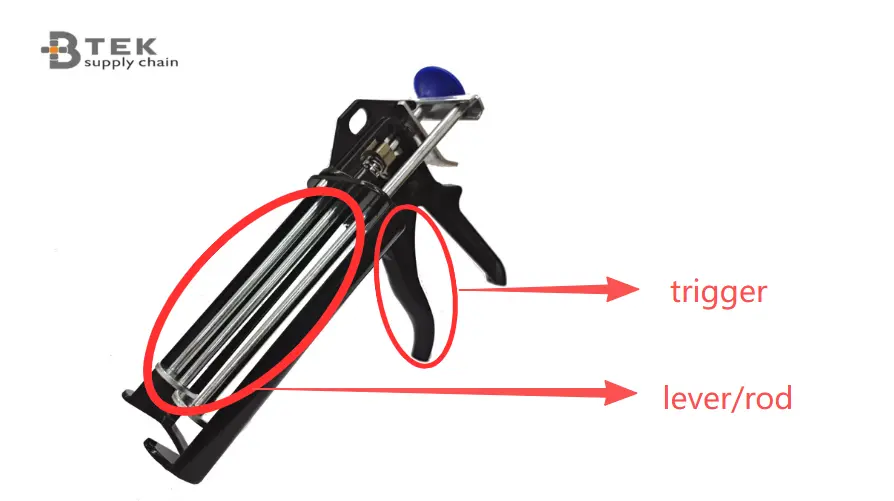
Caulk Gun Release Lever Stuck When Trigger Is Pressed
Why it happens: The drive part or release tab may be worn, the release tab hasn’t been pressed before pulling the lever, or adhesive has built up inside the mechanism and is blocking movement.
Quick fix: Press the release tab firmly with your thumb and pull the lever back. If that doesn’t free it, clean out any accessible adhesive buildup. For a worn drive part, disassemble the plunger assembly with a screwdriver, remove the lever, detach the tab and drive part, and fit a replacement.
How to Prevent: Wipe down the lever mechanism and release tab area after each use to stop adhesive from migrating into the mechanism. Inspect the drive part and tab for early signs of wear during cleaning.
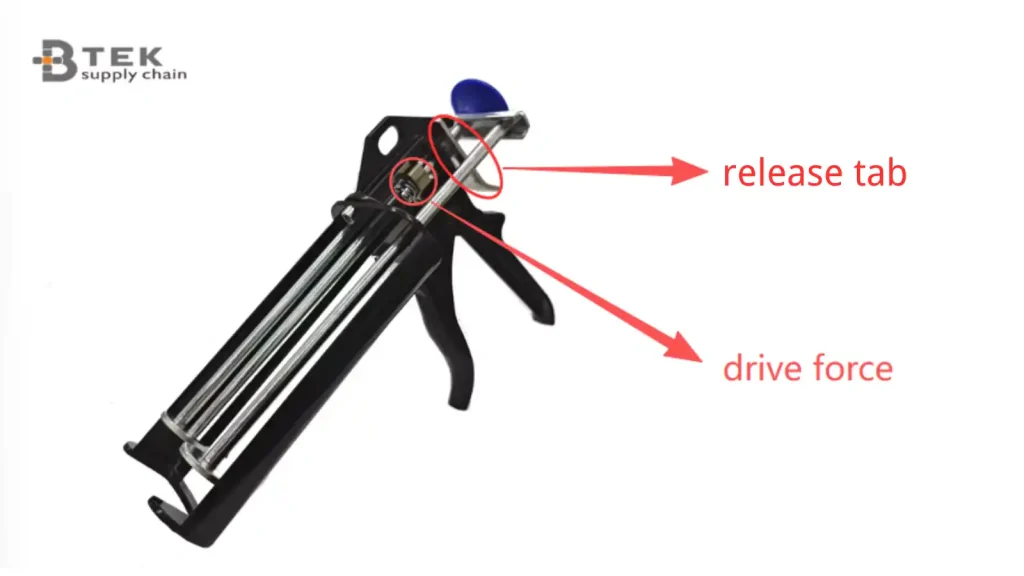
Lever Advances When Pushed but Moves Back When Released
Why it happens: The release tab is worn down or has bent out of its original shape, so it can no longer hold the lever’s position on the return stroke.
Quick fix: Replace the tab if the wear is significant. If it’s only bent rather than damaged, remove it, flip its orientation, and reinstall — this often restores enough tension to work correctly without a full replacement.
How to Prevent: Avoid forcing the lever back without pressing the release tab first. This puts repeated lateral stress on the tab and accelerates bending. Make pressing the tab a habitual first step every time you retract the lever.
Lever Advances but the Drive Part Does Not Return
Why it happens: The drive part is running dry due to lack of lubrication, causing it to bind rather than return freely after each stroke.
Quick fix: Apply a small amount of machine oil to the drive part, press the release tab, and pull the lever back. Work it forward and back several times until movement feels consistently free.
How to Prevent: Lubricate the drive part after regular use. Don’t wait until binding occurs because by that point, wear on the drive part has usually already begun.
Caulk Gun Not Pushing Adhesive / Packaging Breakage or Leakage
Why it happens: Adhesive has cured at the front end or inside the nozzle due to expiry or long non-use, blocking the outlet so pressure escapes from the rear instead. Rapid transfer from a cold environment to room temperature can also cause the material to set near the front.
Quick fix: Pierce through the nozzle with a screwdriver or nail, or use a drill with a screw bit to bore into the front of the cartridge, then dispense to clear the blockage. If you need a clean, controlled bead or are working on a precision application, replace the cartridge entirely.
How to Prevent: Immediately clean any residual adhesive from the tip of the caulk gun after each use, and store the gun in a stable, room-temperature environment. If the gun has been stored in a low-temperature environment, allow it to gradually acclimate to room temperature rather than moving it directly into a warm workspace. Before use, check the expiration date on the adhesive cartridge and ensure that the gun’s plunger is properly aligned with the rear seal of the cartridge to prevent leaks caused by uneven pressure distribution resulting from misalignment.
Nozzle Has Been Cut but Still No Flow
Why it happens: The cut opening is too small to allow flow, or the cut didn’t reach the inner foil seal of the cartridge, leaving it intact and blocking output.
Quick fix: Re-cut the nozzle at a wider angle to create a larger opening. Then insert a long pointed object through the nozzle to puncture the inner seal before dispensing again.
How to Prevent: Before cutting, check that the gun’s lever is fully retracted and centered against the cartridge base. After cutting, cycle the gun once without a cartridge to ensure the drive mechanism moves smoothly.
Conclusion
After reading this blog, you’ll understand why your caulk guns not working and quickly learn how to fix them quickly without replacing the tools.
If you still can’t get it to work after following the steps above, or if you don’t know how to replace parts, then you might need a new caulk gun.
FAQs about Caulk Gun Not Working
When to replace the entire caulk gun rather than just a part?
If multiple components — the drive part, release tab, and lever — are all showing wear at the same time, part-by-part repair becomes less cost-effective than replacement. A gun that requires frequent fixes within a short period is usually indicating that the overall mechanism has reached the end of its service life.
Why does my caulk gun work for a few seconds and then stop?
Intermittent flow is often caused by partial blockage in the nozzle or inconsistent pressure from the drive mechanism. As resistance builds up, the trigger force becomes insufficient to maintain continuous flow.
Why is my caulk gun extremely hard to pull even with a new cartridge?
If a new cartridge still causes strong resistance, the issue is likely related to the gun’s mechanical resistance or mismatch between tool force and material viscosity. High-resistance materials require a stronger dispensing force than standard guns can provide.
Why does the trigger feel loose but nothing is being dispensed?
A loose trigger with no output usually means the drive mechanism is not properly engaging the cartridge. The movement is happening, but it is not being converted into forward pressure on the material.
Why is material coming out slowly even when I fully press the trigger?
Slow output usually indicates that the system is struggling to overcome material resistance. This can be caused by high-viscosity adhesive, increased internal friction, or insufficient mechanical force from the gun.