
The correct epoxy mixing ratio depends on the formulation. Some two-part epoxies require a 1:1 ratio, while others use 2:1, 4:1, 10:1, or another proportion. Before mixing, check whether your adhesive requires measurement by weight or volume. Using the wrong ratio can affect curing, bond strength, and durability.
Already know your ratio? Use the Epoxy Mixing Ratio Calculator below.
What Is the Correct Mixing Ratio for Epoxy?
Two-part epoxy typically consists of a resin and a hardener. When combined, they react to form a cross-linked polymer structure. The manufacturer determines the mixing ratio based on the formulation. A higher resin-to-hardener ratio does not necessarily mean a stronger adhesive or a faster cure.
A 2:1 ratio means two parts of the first specified component for every one part of the second. Here is how different ratios divide a total of 60 units between Part A and Part B.
| Mixing Ratio (A:B) | Part A | Part B |
| 1:1 | 30 | 30 |
| 2:1 | 40 | 20 |
| 3:1 | 45 | 15 |
| 4:1 | 48 | 12 |
| 5:1 | 50 | 10 |
| 10:1 | 54.55 | 5.45 |
| 100:30 | 46.15 | 13.85 |
These quantities are in grams for weight ratios or milliliters for volume ratios. They are calculation examples, not recommended batch sizes.
Check the product label or Technical Data Sheet (TDS) for the ratio, its measurement basis, and the order of the components. Part A is not always the resin. If the specified ratio is 2:1 in B:A order, it becomes 1:2 in A:B order.
Epoxy Mixing Ratio Calculator
Enter the specified A:B ratio, choose weight or volume, and enter either the total quantity or the known amount of one component.
Use the ratio that corresponds to your selected measurement basis. Changing the unit does not convert a weight ratio into a volume ratio. The calculator determines component quantities, not the correct formulation or a safe batch size.
Select a measurement basis and enter your ratio and quantity.
Use the manufacturer’s specified ratio, component order, and measurement basis. Results are theoretical component quantities, not a density conversion or a recommended batch size.
Should Epoxy Be Mixed by Weight or Volume?
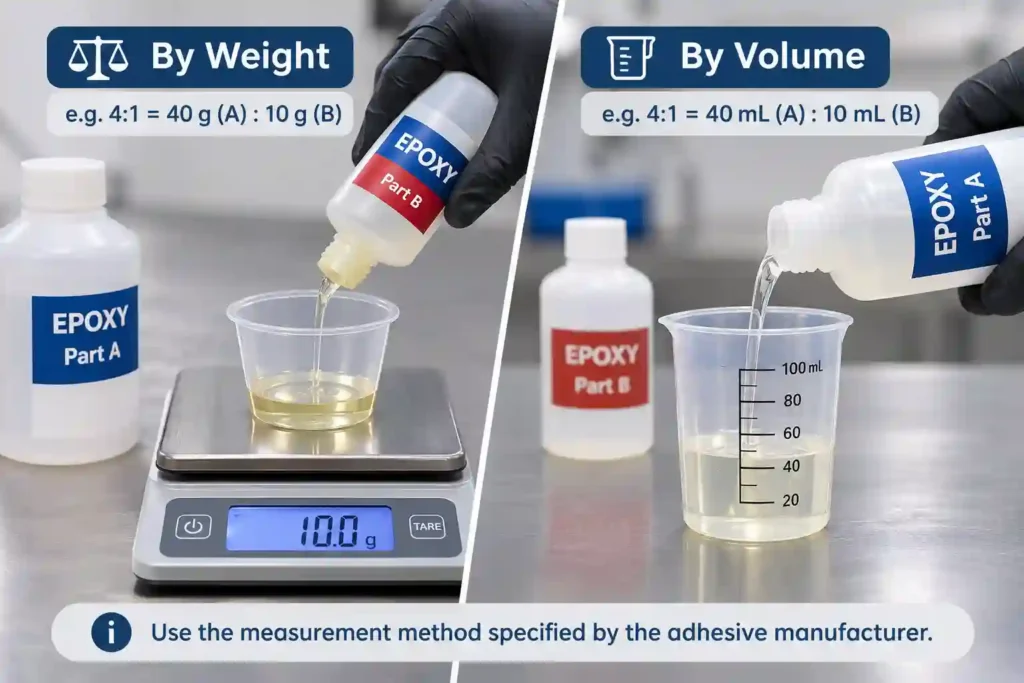
Use the method specified by the adhesive manufacturer.
- By weight: A 4:1 ratio requires 40 g of the first component for every 10 g of the second. You can measure these quantities with a digital scale.
- By volume: A 4:1 ratio requires 40 mL of the first component for every 10 mL of the second. You can use graduated containers or appropriately configured volumetric metering equipment.
Weight and volume ratios are not directly interchangeable unless the component densities are equal. If the manufacturer supplies both ratios, use the published value for your chosen method.
How to Convert Between Weight and Volume Ratios
If only one ratio is available, you need the density of each component to calculate the equivalent ratio.
Weight to volume:
Volume = Mass ÷ Density
Volume ratio = (Mass A ÷ Density A) : (Mass B ÷ Density B)
Volume to weight:
Mass = Volume × Density
Weight ratio = (Volume A × Density A) : (Volume B × Density B)
Use consistent units, such as grams, milliliters, and grams per milliliter.
Consider EPO-TEK H20E, an industrial conductive epoxy. According to Meridian’s technical guide, it has a 1:1 weight ratio, but the two components have specific gravities of 2.03 and 3.07.
Using these values as approximate densities in g/mL:
- 1 g of Part A occupies approximately 0.493 mL.
- 1 g of Part B occupies approximately 0.326 mL.
The equivalent volume ratio is approximately 1.51:1, not 1:1.
This example explains why a 1:1 weight ratio may not match a 1:1 cartridge. Use confirmed density data and obtain technical approval for any converted ratio used in production. The calculation does not establish that H20E is suitable for cartridge repackaging or dispensing.
How to Calculate Resin and Hardener Amounts
Calculating From the Total Quantity
For a mixing ratio of A:B, where A and B are the specified ratio values:
Part A quantity = Total quantity × A ÷ (A + B)
Part B quantity = Total quantity × B ÷ (A + B)
For a combined component volume of 250 mL at a 4:1 ratio:
- Part A = 250 × 4 ÷ 5 = 200 mL
- Part B = 250 × 1 ÷ 5 = 50 mL
The total is the sum of the component quantities before mixing, not a guaranteed final mixed or cured volume.
Calculating From One Known Component
If you know the amount of Part A:
Part B quantity = Part A quantity × B ÷ A
If you know the amount of Part B:
Part A quantity = Part B quantity × A ÷ B
For example, if the required weight ratio is 100:30 and you have 80 g of Part A, multiply 80 by 30 and divide by 100. You need 24 g of Part B, for a total of 104 g.
Before dividing a prepackaged epoxy kit into smaller batches, check whether the manufacturer permits partial mixing.
How to Mix Two-Part Epoxy Correctly
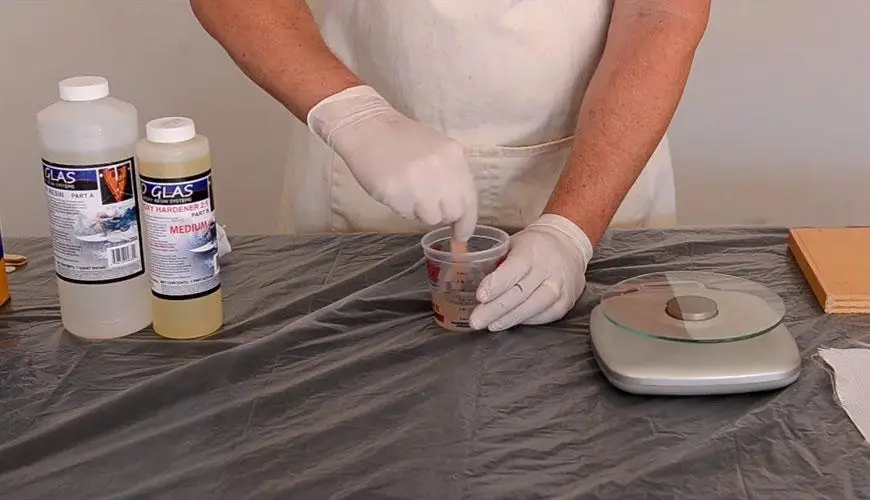
Step 1: Prepare the components. Check whether either component needs to be stirred or homogenized before measuring.
Step 2: Choose the measuring equipment. Use a scale with adequate accuracy for the smaller component quantity or a suitably graduated container. If you use fixed-ratio pumps, verify their output and follow the specified pumping procedure, including complete strokes where required.
Step 3: Measure both components. When weighing, tare the empty container, then record the first component’s weight. Determine the second component’s weight from the increase in the reading, or tare the scale again before adding it.
When measuring by volume, read the graduations rather than estimating quantities by eye. Minimize material left on transfer tools or container walls.
Do you pour resin or hardener first? There is no universal order. Follow the product instructions if they specify a sequence.
Step 4: Mix thoroughly. Use the recommended mixing tool and duration. During hand mixing, incorporate material from the sides and bottom of the container as directed. Avoid unnecessary air incorporation.
Step 5: Observe the working and open-time limits. Complete dispensing, application, and assembly within the applicable time limits. Epoxy generates heat during curing, and large batches can become dangerously hot. Follow the manufacturer’s batch-size and temperature limits, and use the protective equipment and ventilation specified in the Safety Data Sheet (SDS).
What Happens If the Epoxy Mixing Ratio Is Wrong?
Too much or too little hardener can disrupt curing and leave unreacted material. Possible results include soft or sticky epoxy, reduced bond strength, and lower heat or chemical resistance.
The adhesive may still harden despite a ratio error. A hard surface alone does not prove that the bond has reached its intended performance.
Can More Hardener Make Epoxy Cure Faster?
Adding extra hardener is not an appropriate way to speed up curing. If you need a shorter cure time, choose a manufacturer-approved faster-curing formulation or hardener and follow its specified ratio.
Higher temperatures can accelerate curing in many epoxy systems, but they may also shorten working time and increase heat generation. Use only approved heating conditions.
Will Tacky Epoxy Eventually Cure?
That depends on the cause. A ratio error means the overall component quantities are incorrect. Incomplete mixing means the components are not evenly distributed, even if their quantities are correct. Both can cause curing problems.
If the problem is insufficient curing time or unsuitable temperature, additional time or approved curing conditions may help. Significant ratio errors or incomplete mixing may prevent the adhesive from reaching its intended properties.
If a measuring error is discovered while the components are still separate and their quantities are known, correct the amounts if the product instructions allow it. Once the components have been combined, do not try to correct an uncertain ratio by adding more resin or hardener.
Stop using the affected batch, follow the manufacturer’s safety, handling, and disposal instructions, and seek technical guidance before continuing. Do not cover uncured adhesive with fresh material before assessing the problem.
Choosing the Right Epoxy Dispensing System
Hand mixing may be practical for individual batches. On a production line, repeatedly measuring and mixing small quantities can be difficult to control. Calibrated pumps, dual cartridges, and automated meter-mix systems offer different approaches depending on the application.
Why Small Measuring Errors Matter
Consider a 10:1 weight ratio requiring 20 g of Part A and 2 g of Part B. If you measure 2.5 g of Part B instead, its quantity is 25% above the target, and the actual A:B ratio becomes 8:1.
The same absolute measuring error matters more when the required component quantity is small. Check the measuring instrument’s actual accuracy, not just its displayed resolution. There is no universal mixing ratio tolerance for epoxy; use the adhesive manufacturer’s permitted deviation.
How Dual Cartridges Meter Two-Part Epoxy
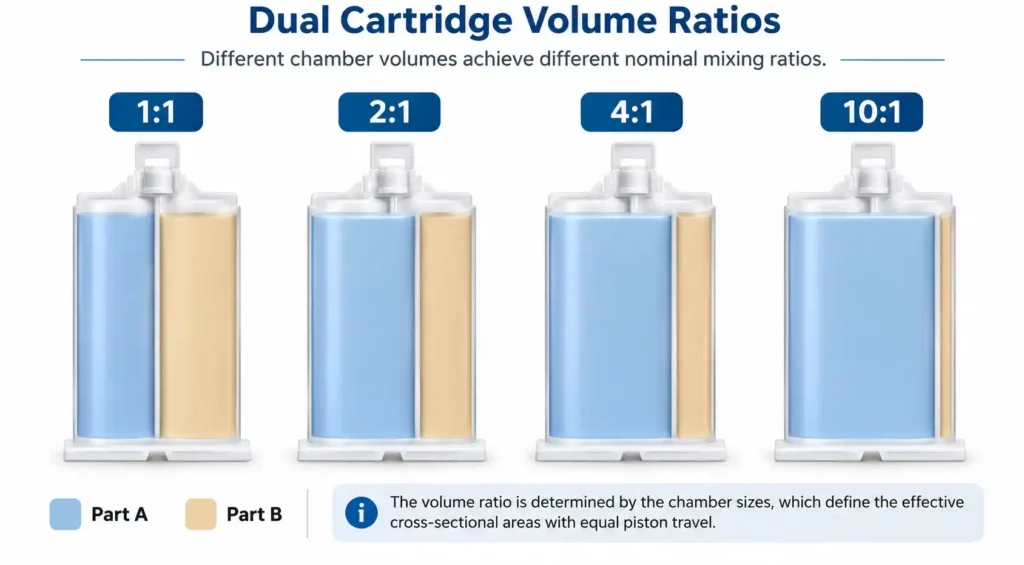
A dual cartridge stores the components in separate chambers. In a conventional system with constant effective chamber cross-sectional areas, the theoretical displaced volume is:
Displaced volume = Effective chamber cross-sectional area × Piston travel
If one chamber has twice the effective cross-sectional area of the other, equal piston movement produces an ideal 2:1 volume ratio.
Different chamber geometries allow dual cartridges for two-part epoxy to provide different nominal volume ratios.
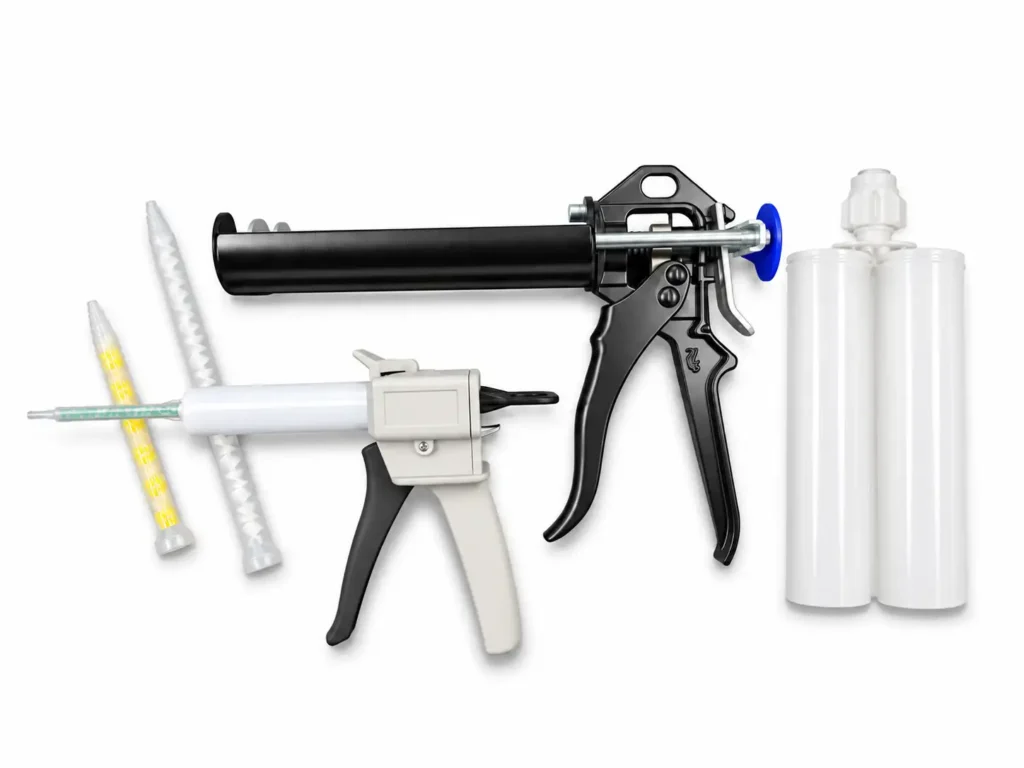
The cartridge provides the metering geometry, the gun drives the pistons, and the static mixer blends the discharged components. A static mixer cannot independently correct an incorrect incoming ratio. Its flow resistance can also affect dispensing stability.
A cartridge’s nominal ratio does not guarantee its actual output ratio. Where proportioning is critical, verify the delivered A:B ratio using an approved measurement procedure.
Matching the Cartridge, Gun, and Static Mixer
When selecting dual cartridge dispensing guns and static mixing nozzles, check their compatibility with the cartridge, adhesive, and application.
| Selection Factor | What to Check |
| Mix ratio | Required volume ratio and component order |
| Cartridge | Chamber ratio, capacity, geometry, and material compatibility |
| Dispensing gun | Matching piston arrangement, cartridge geometry, and operating requirements |
| Static mixer | Inlet connection, component properties, flow resistance, and mixing requirements |
| Process validation | Actual output ratio, mixing quality, and required adhesive performance |
If the required volume ratio does not match an available cartridge, do not round it to the nearest standard ratio without technical approval. An alternative packaging configuration or metering system may be necessary.
For inconsistent component output, see our guide to troubleshooting off-ratio dispensing.
Conclusion
If you are selecting a cartridge or dispensing system for two-part epoxy, contact BTEKTECH with your adhesive’s specified mixing ratio, technical data, packaging requirements, and dispensing conditions. We can help you evaluate suitable packaging and dispensing options.