
Both components are coming out of your dual-cartridge dispensing gun, but something doesn’t look right. Part A may start before Part B, one side may lag, the plungers may not engage as expected, or an adhesive that normally cures properly may remain soft or tacky. These can be signs of 2K adhesive off-ratio dispensing.
Off-ratio dispensing means the actual amount of Part A relative to Part B doesn’t match the ratio required by the adhesive and cartridge system. It doesn’t simply mean the two sides look different. In a cartridge configured for a 2:1, 4:1, or 10:1 ratio by volume, different A- and B-side output volumes are expected by design. The real question is whether the dispensing system is maintaining the intended A:B relationship, not whether the two streams look equal.
This guide focuses specifically on diagnosing off-ratio output in dual-cartridge 2K adhesive systems. If your gun won’t dispense at all, the trigger or rod is jammed, or you’re dealing with a general dripping or drive problem, our caulk gun troubleshooting guide covers that instead.
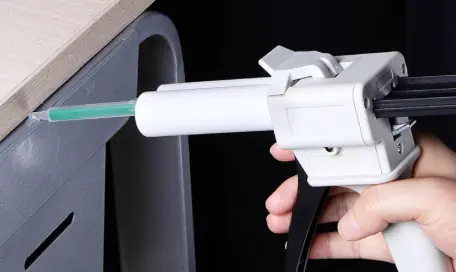
Quick Diagnosis: Is This Really an Off-Ratio Problem?
You may have an off-ratio or metering problem if Part A consistently starts before Part B (or vice versa), one side shows obvious lead-lag during startup, one plunger doesn’t engage or advance as expected, the relative A/B output changes during dispensing, the observed output relationship looks inconsistent with the cartridge’s specified ratio, or an adhesive that normally cures correctly becomes unexpectedly soft, tacky, or inconsistent.
But not every unusual bead is an off-ratio problem.
| What You See | More Likely Problem | Check First |
| A/B output relationship appears incorrect | Off-ratio / metering | Cartridge ratio, gun/plunger setup, piston engagement |
| A/B flow appears normal before the mixer, but the mixed bead is streaky | Poor mixing | Static mixer, mixer priming, compatibility |
| Neither component dispenses normally | General dispensing problem | Gun drive, blockage, cartridge condition |
| Adhesive remains soft or tacky | Result symptom; multiple causes possible | Ratio, mixing, material and process conditions |
| A and B look unequal, but the relationship stays stable and matches the specified cartridge ratio | Possibly normal for a non-1:1 system | Confirm the nominal ratio by volume |
A soft or tacky cure is a reason to investigate the ratio, not proof that the ratio is wrong.
What Is Off-Ratio Dispensing in a 2K Adhesive System?
Two-component adhesives use separate Part A and Part B materials that must be dispensed in a defined proportion before mixing. Common dual-cartridge ratios include 1:1, 2:1, 4:1, and 10:1. Off-ratio dispensing occurs when the actual A:B delivery deviates from that required relationship. A cartridge configured for a 2:1 ratio by volume is not supposed to deliver equal A and B volumes; one chamber is designed to deliver approximately twice the volume of the other. That’s why “uneven output” shouldn’t automatically be read as a problem, what matters is whether the relative output is wrong, unstable, or inconsistent with the specified cartridge ratio, not whether the two streams look unequal.
Nominal Mix Ratio vs. Actual Dispensing Ratio
The nominal mix ratio is the ratio specified for the adhesive and cartridge system. The actual dispensing ratio is what the applicator is really delivering. A cartridge may be designed as a 2:1 system, but the actual output can still become temporarily or persistently off-ratio because of incorrect gun or plunger configuration, improper piston engagement, trapped air and lead-lag, cartridge or seal problems, or unstable startup conditions.
There’s another distinction worth knowing: a ratio by volume isn’t necessarily the same as a ratio by weight. Fixed-ratio dual-cartridge systems typically meter components volumetrically, through cartridge geometry and controlled piston displacement. If an adhesive’s technical data sheet gives a ratio by weight, don’t automatically assume that same numerical value is the required cartridge volume ratio, Part A and Part B may have different densities. Some technical data sheets list weight and volume ratios separately, so it’s worth checking which one you’re actually looking at.
Off-Ratio vs. Poor Mixing: What’s the Difference?
Off-ratio dispensing and poor mixing are related, but they’re not the same problem. Metering happens before mixing, the cartridge and dispensing configuration determine how much Part A and Part B are delivered, and the static mixer then blends those already-metered streams. That means a system can have the correct A:B ratio but poor mixing, an incorrect A:B ratio that still looks visually well blended, or both problems at once.
If the relative amount of A versus B is wrong, investigate the upstream dispensing system: cartridge ratio, gun and plunger configuration, push disks, piston engagement, trapped air, cartridge deformation, or piston and seal leakage.
If both components are being delivered correctly but the final bead is streaky, two-toned, or insufficiently blended, investigate the static mixer instead. For mixer-specific problems, our guide to common epoxy mixing nozzle mistakes covers that.
Mix Ratio Is Not Thrust Ratio
These two specs get confused often enough to call out directly. A mix ratio, like 2:1 or 10:1, describes the required A:B material relationship. A thrust ratio, like 18:1 or 26:1 on a manual dispensing gun, describes mechanical advantage and available dispensing force, two completely different things. A 2:1 adhesive doesn’t require a “2:1 thrust-ratio gun.” Multi-ratio dual-cartridge systems instead use different plungers, push disks, conversion hardware, or cartridge trays to accommodate different cartridge geometries. The key point: more dispensing force cannot correct an incompatible A:B metering configuration, no matter how much thrust the gun delivers.
What Usually Causes Off-Ratio A/B Output?
Most off-ratio problems in dual-cartridge systems fall into five practical root-cause groups:
- Incorrect cartridge-to-gun configuration: The applicator, plungers, push disks, conversion hardware, and cartridge all need to be configured for the same cartridge system. If the metering geometry doesn’t match, correct A:B delivery can’t be assumed.
- Unequal plunger or piston engagement: One side may begin moving later or fail to transfer movement correctly because of incorrect disk positioning, poor cartridge seating, incomplete piston contact, or mechanical misalignment.
- Trapped air and startup lead-lag: Compressible air can temporarily delay material movement on one side and disturb the expected A:B relationship, particularly at startup.
- Cartridge, piston, or seal problems: Deformation, blow-by, seal leakage, or piston problems can prevent piston movement and material output from corresponding normally.
- Improper equalization or purging: If one component hasn’t reached a stable outlet condition before application begins, the first portion of the dispense may not reflect the intended steady-state A:B relationship.
How to Diagnose 2K Off-Ratio Dispensing, Step by Step
Don’t replace several components at once, isolate the problem in a fixed sequence instead. Before inspecting the system, follow the adhesive SDS and equipment instructions, wear the required PPE, and depressurize pneumatic equipment before changing components.
Step 1: Confirm the adhesive’s specified A:B ratio.
Check the manufacturer’s technical information for the specified ratio, whether it’s stated by volume or weight, compatible cartridge format, recommended dispensing equipment, and any specified ratio tolerance. Don’t determine the required ratio from bead appearance alone.
Step 2: Confirm the cartridge and gun configuration.
Check cartridge size, format, and volumetric ratio, the applicator model, plunger or push-disk configuration, and any conversion components in use. A cartridge physically fitting into a dispensing gun doesn’t automatically mean the two are correctly matched, different cartridge ratios may call for different plungers, push disks, or conversion components. If the metering geometry is wrong, a gun with more dispensing force won’t correct the A:B ratio.
If you’re checking whether the applicator matches your cartridge, compare our dual cartridge gun configurations by cartridge volume and mix ratio before replacing or reconfiguring the dispensing setup.
Step 3: Check both plungers and pistons for proper engagement.
Confirm the cartridge is seated correctly and both sides of the drive system contact the cartridge pistons as intended. Look for one push disk contacting later than the other, incorrect disk size or position, incomplete piston contact, cartridge misalignment, bent or damaged drive components, or incorrectly installed conversion parts. If one side doesn’t transmit plunger movement correctly, A/B delivery can become unstable.
Step 4: Check A/B flow before mixing, where the system allows it.
A useful isolation test is observing the individual components before they enter the static mixer, when the adhesive and cartridge manufacturer’s instructions permit this. Check whether Part A flows, whether Part B flows, whether there’s a clear delay on one side, whether either side hesitates or stops, and whether the output relationship looks consistent with the cartridge ratio. Don’t expect equal streams from every cartridge, a 2:1 or 10:1 cartridge is intentionally asymmetric, and this is only a screening check, not a substitute for an actual ratio measurement. If the system requires removing the mixer for inspection, follow the manufacturer’s procedure, and don’t reuse a contaminated or partially cured mixer unless the manufacturer specifically permits it.
Step 5: Check for trapped air and A/B lead-lag.
Trapped air matters here because air is compressible. If air is trapped on one side, part of the initial plunger movement compresses that air instead of immediately displacing adhesive, so the plunger starts moving, the trapped air compresses, material movement on that side is briefly delayed, the opposite component begins flowing first, the initial dispense runs temporarily rich in one component, and the output relationship shifts again as pressure stabilizes. That sequence is what’s meant by A/B lead-lag. The practical issue isn’t just that air bubbles are present, it’s that compressible air can interrupt the expected relationship between piston movement and immediate material delivery. If startup imbalance keeps happening, inspect the cartridge and follow the manufacturer’s filling, storage, equalization, and purge instructions.
Step 6: Inspect the cartridge, pistons, and seals.
Look for cartridge deformation, displaced or damaged pistons, material leaking behind a piston, piston bypass or blow-by, seal failure, abnormal cartridge expansion, or visible package damage. A leak belongs in off-ratio troubleshooting only when it changes the relative delivery of A versus B, a general cartridge leak with no ratio implication belongs in normal dispensing-gun troubleshooting instead.
Step 7: Equalize and purge according to the manufacturer’s instructions.
Both components should reach a stable starting condition before normal application. The exact procedure varies by adhesive and cartridge system, so avoid applying one universal purge quantity to every product, the goal is stable A- and B-side flow, removing unstable startup material, and avoiding an initially unbalanced dispense on the workpiece. For the full loading and startup process, our guide to using a two-component manual caulking gun covers that.
Step 8: Verify the actual A/B output.
If the previous checks don’t reveal a clear fault, or ratio accuracy is critical to the application, it’s worth verifying actual output directly, through volumetric measurement, weight-based measurement with the correct density relationship, controlled sample collection, or a manufacturer-defined procedure, depending on the system. Don’t rely only on color, bead appearance, two streams that “look about right,” or apparent cure as proof. Where quantitative confirmation is required, follow the adhesive or dispensing-system manufacturer’s approved ratio-verification procedure.
Can a Static Mixer Cause Off-Ratio Dispensing?
Not as the primary metering element. In a fixed-ratio dual-cartridge system, the cartridge geometry and compatible dispensing mechanism establish the nominal A:B delivery relationship, while the static mixer blends the two streams downstream.
That said, a mixer can still influence overall dispensing behavior through flow resistance. A blocked, partially cured, unsuitable, or excessively restrictive mixer can increase upstream backpressure, and while increased mixer resistance doesn’t automatically mean the nominal ratio changes, that added pressure can expose weaknesses like cartridge deformation, piston lag, seal bypass, or other compliance within the dispensing system. If A/B instability only shows up when dispensing against high resistance, investigate the complete cartridge-gun-mixer system rather than assuming the mixer alone controls the ratio.
Off-Ratio Troubleshooting Chart
| Symptom | Possible Cause | What to Check | Corrective Action |
| A starts before B, or B starts before A | Lead-lag, trapped air, incomplete engagement | Pre-mixer A/B flow and piston contact | Equalize/purge as specified; inspect cartridge and pistons |
| One plunger advances abnormally | Wrong disk, poor engagement, misalignment | Push-disk/plunger configuration | Correct hardware setup |
| A/B relationship is consistently wrong | Cartridge/gun configuration mismatch | Cartridge ratio vs. applicator setup | Use the correct ratio-specific configuration |
| Output changes during dispensing | Cartridge deformation, piston bypass, seal problem | Cartridge body, pistons and seals | Replace the defective component |
| A/B appears normal before the mixer but the bead is streaky | Poor mixing | Mixer condition, priming and compatibility | Follow mixer troubleshooting |
| Adhesive remains soft or tacky | Off-ratio, poor mixing, material or process problem | Actual ratio, mixing, TDS and process conditions | Diagnose before changing equipment |
| No obvious mechanical fault but ratio is uncertain | Actual output has not been verified | Perform ratio verification | Compare measured output with the adhesive specification |
How Do You Know the Off-Ratio Problem Is Fixed?
Don’t stop troubleshooting just because the bead looks better, confirm it at three levels.
Mechanical check: confirm the cartridge and applicator configuration match, the correct plungers or push disks are installed, both cartridge pistons are properly engaged, and there’s no obvious mechanical or cartridge damage.
Dispensing check: confirm both components begin dispensing normally, no abnormal lead-lag is present, output stays stable, and there’s no visible blow-by, leakage, or deformation affecting one side.
Ratio verification: where ratio accuracy matters, confirm the actual A:B output meets the adhesive manufacturer’s specification or permitted tolerance. Uniform color, equal-looking streams, bead appearance, or the fact that the adhesive seems to cure can support your troubleshooting, but none of them replace an actual verification procedure on their own.
For quality-critical bonding or production work, don’t return the process to normal production while the dispensing ratio remains uncertain. Follow the adhesive supplier’s instructions and your internal quality-control requirements before accepting the process again.
How to Prevent Off-Ratio Dispensing
Most ratio problems are easier to prevent than to diagnose after a failed application. Before dispensing: confirm the required adhesive ratio and whether it’s specified by volume or weight, use the correct cartridge format and ratio-specific applicator configuration, check plunger, push-disk, and piston engagement before applying full force, don’t use visibly damaged or deformed cartridges, equalize and purge according to the manufacturer’s instructions, use a static mixer compatible with the adhesive and cartridge system, and recheck the setup whenever the adhesive, cartridge format, applicator configuration, or process conditions change.
FAQs About 2K Off-Ratio Dispensing
Why is one side of my dual cartridge dispensing faster?
First check whether the difference is actually abnormal, a 2:1, 4:1, or 10:1 cartridge is designed to dispense different component volumes. If one side starts unusually late, stops intermittently, or the A:B relationship changes during use, check the gun/cartridge configuration, piston engagement, trapped air, and cartridge condition.
Why are Part A and Part B not dispensing evenly?
If “evenly” means equal quantities, that’s only appropriate for certain systems, like 1:1 cartridges. The real question is whether A and B are being delivered in the correct proportion, not whether they look equal.
Can the wrong dispensing gun cause an incorrect mix ratio?
Yes, if the applicator, plunger, push disk, cartridge tray, or conversion configuration is incompatible with the cartridge geometry. A cartridge physically fitting into a gun doesn’t prove the metering setup is correct.
Can trapped air cause off-ratio dispensing?
Trapped air can contribute to A/B lead-lag and temporary metering instability. Because air compresses under pressure, piston movement may initially compress an air pocket rather than immediately displacing adhesive on that side.
Does the static mixer control the A/B ratio?
Not as the primary metering element. In a fixed-ratio dual-cartridge system, the cartridge and compatible dispensing mechanism establish the nominal A:B delivery relationship, while the static mixer blends the already-metered streams. A blocked or overly restrictive mixer can still increase backpressure and expose upstream dispensing problems.
Can an incorrect 2K mix ratio cause epoxy to stay tacky?
Yes, an incorrect component ratio can interfere with cure and final performance. But tackiness can also come from poor mixing, material condition, temperature, or contamination, so treat it as a warning sign rather than proof of off-ratio dispensing.
How do I check whether my 2K adhesive is dispensing at the correct ratio?
Confirm the adhesive specification first, including whether its ratio is defined by volume or weight, then check the cartridge and applicator configuration. If quantitative confirmation is required, measure actual A/B output using an appropriate volumetric, weight-based, or manufacturer-approved method.
Final Check Before Returning to Production
Before resuming normal 2K adhesive dispensing, confirm: the required A:B ratio is known, the ratio basis (volume or weight) is understood, the cartridge format is correct, the applicator and plunger/push-disk configuration match the cartridge, both pistons are properly engaged, no significant cartridge deformation, blow-by, or seal failure is visible, no abnormal A/B lead-lag remains, both components deliver normally before mixing where the system permits this check, startup material has been equalized and purged according to the manufacturer’s instructions, the static mixer is compatible and unobstructed, and actual A:B output has been verified when the application requires quantitative confirmation. If the ratio still can’t be confirmed, don’t treat visual appearance alone as acceptance.
Need Help Checking Your Gun-Cartridge Setup?
If your dual-cartridge system is showing unusual A/B output and you’re not sure whether the problem comes from the cartridge, dispensing gun, plunger configuration, or application setup, send us the cartridge size and format, specified A:B mix ratio and its basis (volume or weight) if known, your current dispensing-gun model, the adhesive product or TDS, the application, working temperature and approximate viscosity if known, and the symptom you’re seeing. With those details, we can help determine whether the issue is more likely related to metering, mixing, cartridge compatibility, or dispensing-tool configuration, and identify what to check first.