home / Dispensing Tips / Blunt Tip Needles
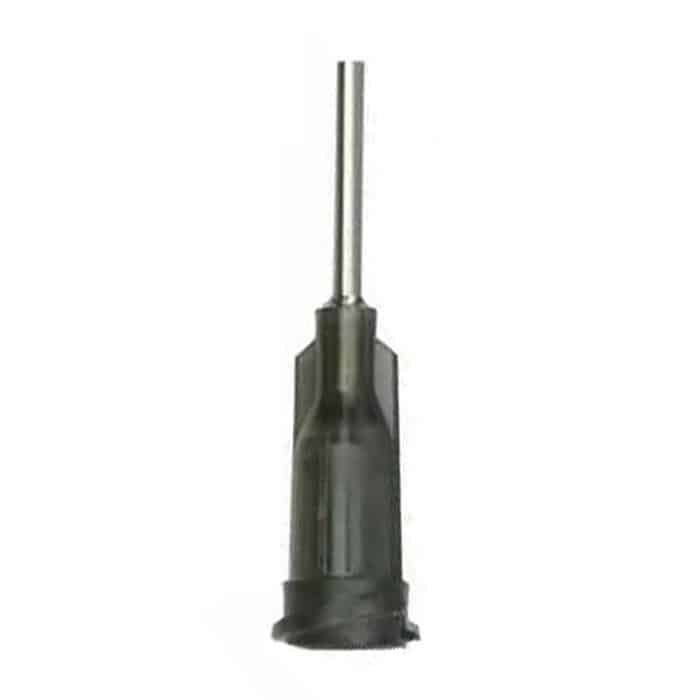
Blunt Tip Needles

Blunt Tip Needles

Safe fluid dispensing, less surface scratching and puncture risk

Blunt tip needle protect sensitive substrates during adhesive, lubricant, and solder paste application. Available in multiple gauges and lengths with PP or metal hub options, the stainless-steel cannula maintains consistent flow across general industrial and laboratory dispensing tasks.

Get a Quick Quote

Key Advantages of Blunt Tip Needles

Blunt tip structure improves operating safety, flow stability, and material compatibility across standard dispensing applications.
  • Reduced Risk: The blunt end needle lowers the chance of scratching sensitive substrates or causing accidental punctures.
  • Consistent Flow Performance: The precision-bore stainless-steel cannula helps maintain stable output and reduces the likelihood of clogging.
  • Hub Material Flexibility: PP and metal hub options allow you to balance cost, rigidity, and process conditions.
  • Secure Connection: The luer lock blunt needle provides a twist-lock fit between the needle and syringe or dispensing system.
Request For Our Latest Price

Available Blunt Tip Needles Configurations

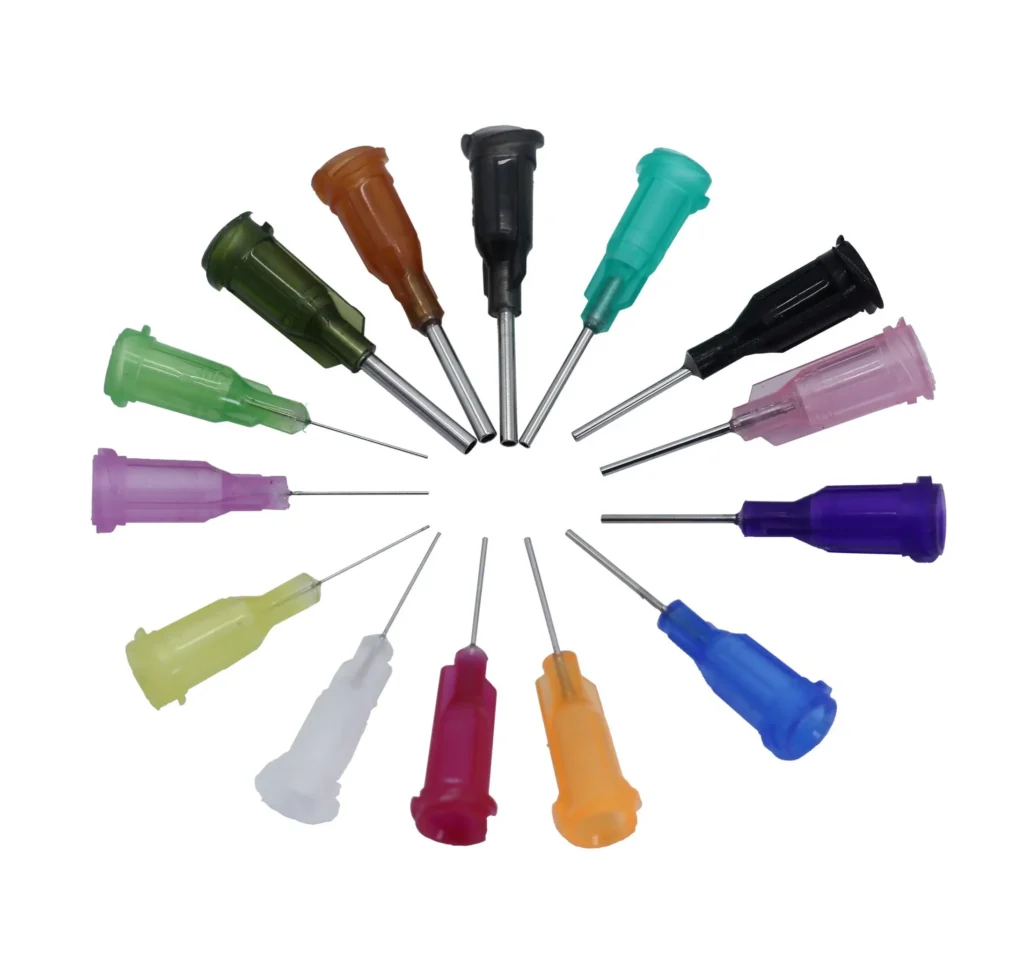
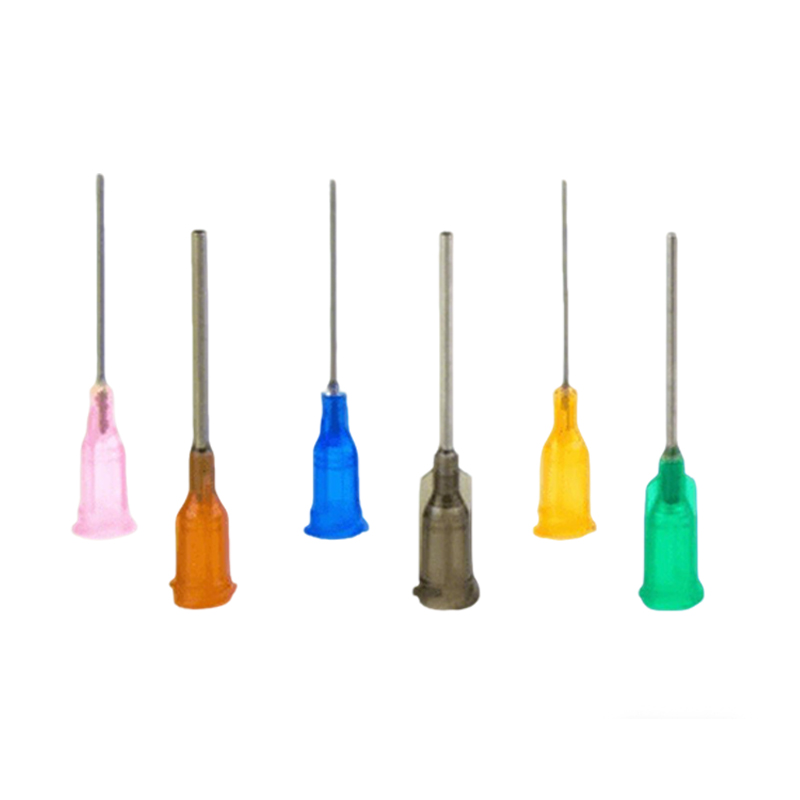
Blunt tip needles are available in gauges ranging from 14 to 32, covering inner diameters from 0.11 mm to 1.45 mm across four standard lengths: 6.35 mm, 12.7 mm, 25.4 mm, and 38.1 mm. PP or metal hub options are available to match different mechanical and cost requirements across industrial and laboratory dispensing tasks.

Gauge Color ID(mm) OD(mm) 6.35mm (1/4″) 12.7mm (1/2″) 25.4mm (1″) 38.1mm (3/2″)
14 Olive 1.54(0.06″) 1.83(0.072″) 9018029 9018043 9018032 9018035
15 Amber 1.36(0.053″) 1.65(0.065″) 9018056 9018068 9018059 9018062
16 Grey 1.19(0.047″) 1.64(0.06”) 9018072 9018073 9018074 9018075
18 Green 0.84(0.033″) 1.27(0.05″) 9018107 9018122 9018110 9018113
20 Pink 0.61(0.024″) 0.91(0.036″) 9018163 9018716 9018166 9018169
21 Purple 0.51(0.02″) 0.82(0.032″) 9005005 9018233 9018222 9018225
22 Blue 0.41(0.016″) 0.72(0.028″) 9018260 9018272 9018263 9018266
23 Orange 0.33(0.013″) 0.65(0.025″) 9018302 9018314 9018305 9018308
25 Red 0.25(0.01″) 0.52(0.02″) 9018333 9018345 9018336 9018339
27 Clear 0.2(0.008″) 0.42(0.016″) 9018395 9005008 N/A N/A
30 Lavender 0.15(0.006″) 0.31(0.012″) 9018424 9018433 N/A N/A
32 Yellow 0.1(0.004″) 0.24(0.009″) 9018452 N/A N/A N/A

How to Choose Blunt Tip Needles

  • Hub and Needle Material: A PP hub with a stainless-steel needle for a cost-effective option; a full-metal version for higher mechanical strength and rigidity; and a full PP option for chemical compatibility and lower cost.
  • Needle Length: Long blunt needle is suited to recessed dispensing point. Short blunt needle is preferable when dispensing onto open surfaces. It is also necessary to check whether the flow rate is suitable for the length.
  • Needle Width: A larger inner diameter allows higher flow output, while a smaller inner diameter provides finer control for precise placement. For materials with particulate fillers, selecting an diameter with sufficient clearance.

Customization Options for Blunt Tip Needles

Standard blunt tip needles may not cover every application requirement. Customization allows them to be adjusted to fit specific process conditions.

OEM Build

OEM Build

Produce needles to your approved drawing, with specified dimensions, tolerances, and connection format.

ODM Layout

ODM Layout

Develop customized blunt needles configurations based on application requirements.

Custom Specifications

Custom Specifications

Adjust gauge, length, material combination, and color to match non-standard process or equipment conditions.

Private Label

Private Label

Apply engraved logos and configure packaging format to support your own product line or distribution requirements.

Excellent Performance in Industrial Applications

Across electronics, automotive, and lab settings, blunt tip needles enable precise, repeatable application of adhesives, sealants, and coatings for controlled assembly and processing.

Blunt Dispensing Needle in Electronics & SMT Assembly

Electronics & SMT Assembly

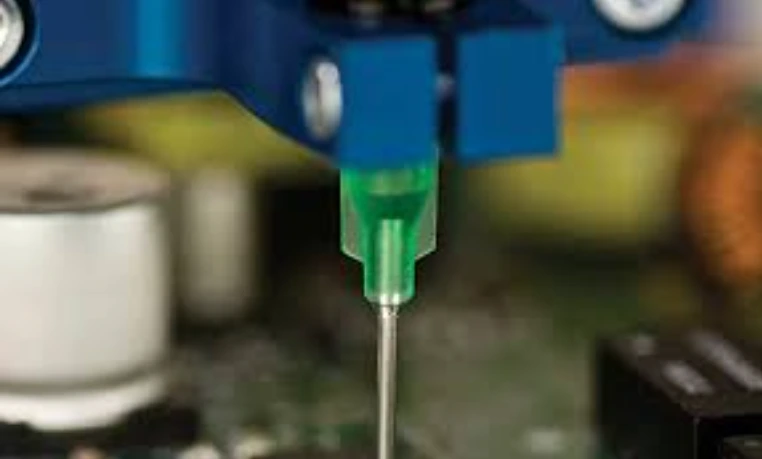
Blunt dispensing needles are widely used in electronics manufacturing and SMT production for applying adhesives, conformal coatings, and potting compounds on circuit boards and components. Blunt needles are preferred here because the flat, open tip delivers material to a precise point without piercing or damaging delicate board surfaces, fine-pitch components, or nearby traces.

Send Inquiry Now
Blunt Dispensing Needle in Automotive Assembly & Sealing

Automotive Assembly & Sealing

In automotive assembly and maintenance processes, blunt tip needles are applied for sealants, lubricants, and adhesives in confined or hard-to-reach areas. They enable stable material flow along seams, joints, and sealing paths, supporting repeatable dispensing performance in both manual and semi-automated operations.

Send Inquiry Now
Blunt Dispensing Needle in General Laboratory & Industrial Applications

General Laboratory & Industrial Applications

Blunt tip needles are commonly used in laboratory work, chemical processing, and light industrial assembly for fluid transfer and surface coating. They help maintain consistent flow across different materials and support controlled application in small-scale, detail-oriented processes.

Send Inquiry Now

Frequently Asked Questions About Blunt Tip Needles

What types of materials can be dispensed with blunt tip needles?

They are commonly used for adhesives, silicones, lubricants, solvents, coatings, and other compatible fluids. Final suitability depends on fluid viscosity, filler content, curing behavior, and the selected needle/hub construction.

Are blunt needles compatible with standard luer lock syringes and valves?

+

Can blunt tip needles be reused?

+

What is the difference between a PP hub and a metal hub?

+

Can blunt tip needles be used with two-component materials before mixing?

+

Learn More About Blunt Tip Needles

Our blog is designed to help you deepen your knowledge of fluid dispensing processes, optimize your production line, and select the best components for your specific challenges. Explore articles that connect industry insights with practical solutions.

View Related Blog →