
If identical syringe dispense cycles produce different deposits, the cause may be trapped air, changing viscosity, syringe fill level, pressure, or tip resistance. This guide shows you how to isolate those variables and improve repeatability in pressure-assisted dispensing.
What Shot-to-Shot Variation Looks Like
Start by describing the change you can measure. You may see a smaller first deposit after filling, a dose that drifts as the syringe empties, pulsing during a dispense cycle, stringing or dripping after cutoff, or a bead whose width changes even though the programmed settings stay the same.
These symptoms do not all point to the same fault. Record whether the variation appears at startup, after a pause, as the material level drops, or throughout the run. Also note whether you use a manual plunger, a pressure-time syringe dispenser, or a positive-displacement metering system; the cause-and-effect relationship is different for each method.
What Causes Syringe Dispensing to Vary?
Trapped Air and Incomplete Priming
Air is compressible, while most dispensing fluids are not. If air remains in the syringe or enters the fluid path during filling, part of the applied pressure may compress the air before the material begins to move. You may see a delayed first shot, pulsing, bubbles, or a deposit that changes after the system has been running for a while.
Use a filling and priming method approved for your material. Do not assume that vacuum degassing or another generic air-removal method is suitable for every reactive, moisture-sensitive, or light-sensitive adhesive.
Changing Fill Level in Pressure-Time Systems
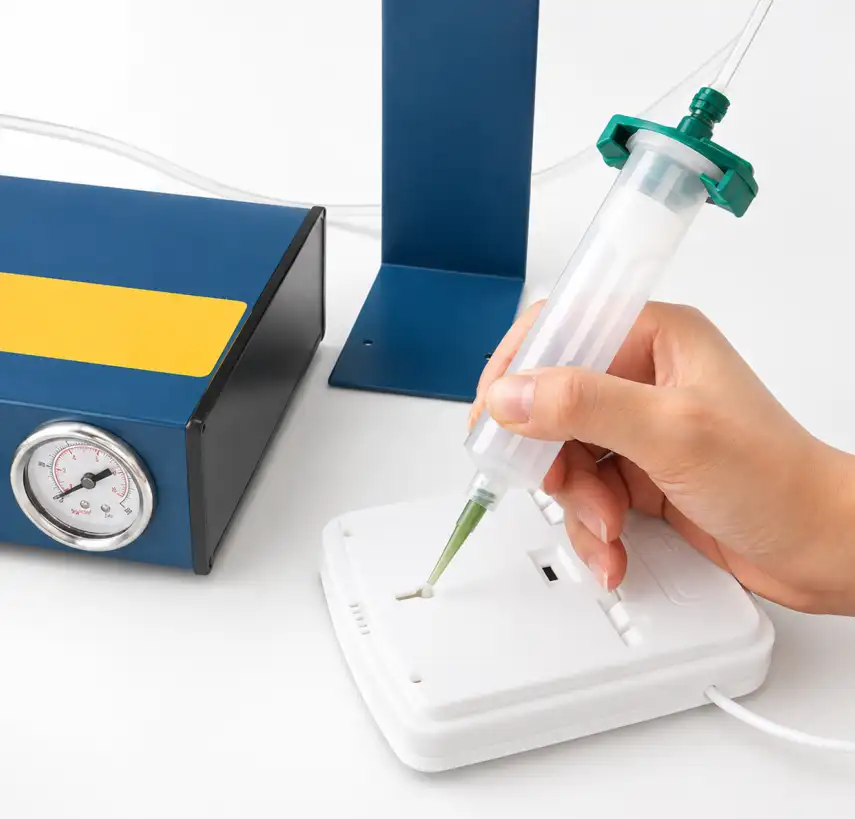
In a pressure-time system, the controller applies air pressure for a set period to push material through the syringe tip. As the syringe empties, the air space behind the piston increases. The same pressure and dispense time may then produce a different amount of material—a behavior often called the full-to-empty effect.
This effect is most relevant to pressure-time dispensing. A positive-displacement system works differently, so identify your dispensing method before using fill level as the explanation for a changing dose. If you need tight repeatability from a pressure-time setup, test the dose at the beginning, middle, and end of the syringe rather than validating only a full barrel.
Changes in Viscosity and Temperature
The material’s viscosity affects how readily it moves through the barrel and tip. A colder adhesive may require more pressure or time to dispense the same amount, while a warmer material may flow more easily. Viscosity can also change as a material ages or approaches its working-time limit.
Keep the material within the temperature and handling range stated by its supplier. During a comparison, use the same material lot and allow the syringe and fluid to stabilize before you measure output.
Tip Resistance or Partial Blockage
The tip’s internal diameter, length, outlet shape, and any bends affect flow resistance. A narrow or long tip may be necessary for placement, but it can increase the pressure needed to dispense a viscous or filled adhesive. Cured residue or contamination can gradually restrict the opening and reduce the deposit.
Choose the tip based on the material, target deposit, and access requirements. If you see a sudden increase in resistance or a changed bead shape, inspect the outlet and replace a blocked disposable tip rather than forcing material through it.
Barrel, Piston, and Seal Fit
The syringe barrel and piston work together to contain the material and transfer pressure. A dimensional mismatch, worn piston, damaged barrel wall, or unsuitable material contact can cause leakage or inconsistent movement. Capacity alone does not establish compatibility: check the barrel series, internal diameter, piston design, and outlet connection.
Pressure, Dispense Time, and Cutoff Settings
In pressure-time dispensing, pressure and time both affect the amount delivered. Fluctuations in the air supply, an inconsistent regulator setting, a changed dispense timer, or an unsuitable vacuum suck-back setting can alter the deposit or cause dripping after cutoff. Check the controller, regulator, tubing, and cutoff behavior before you change the material or barrel.
How to Troubleshoot and Improve Repeatability
Stabilize the Material and Operating Conditions
Use the same material lot, temperature, syringe format, tip, pressure, and dispense time while you establish a baseline. If the material is temperature-sensitive, record the actual material temperature rather than relying only on room temperature. Follow the adhesive supplier’s instructions for storage, conditioning, and working time.
Inspect the Filling Process, Barrel, and Piston
Look for trapped air, incomplete filling, contamination, barrel damage, and a piston that does not fit the barrel correctly. Confirm that the barrel is compatible with the dispensing tool. If the problem began immediately after a refill, investigate the filling and priming steps before replacing the whole dispenser.
Match the Tip to the Material and Deposit
Check the tip’s bore, length, and outlet against your adhesive viscosity and target deposit. A larger bore or shorter tip may reduce unnecessary resistance, but it can also change bead size and placement. Validate any change with the actual material and application; do not increase pressure beyond the equipment or syringe rating.
You can compare available industrial dispensing tips by material, gauge, length, and connection. If you are selecting a new reservoir or piston, review the syringe barrel and cartridge range and confirm the exact series and interface.
Run a Controlled Repeatability Test
Use a fixed test sequence rather than judging one good or bad shot. Record the material lot, temperature, syringe capacity and fill level, piston type, tip identifier, pressure, dispense time, cycle interval, and the measurement method. Measure a series of consecutive deposits at startup and after a defined pause; for pressure-time systems, repeat the test at different fill levels.
Change one variable at a time—such as tip, pressure, time, or barrel format—and compare the full sequence. Set the acceptance tolerance from your product specification or validated manufacturing process. There is no single shot-to-shot tolerance that applies to every adhesive, syringe size, and application.
Check Whether the Dispensing Method Meets Your Accuracy Requirement
If your process remains too sensitive to fill level, viscosity, or pressure fluctuations, discuss the metering method with your equipment supplier. A different dispensing approach may be needed for a process that requires tighter volume control than a pressure-time system can provide. Do not compensate for an unsuitable setup by making uncontrolled pressure changes.
This article focuses on process variation in pressure-assisted syringe dispensing. If your issue is a sticking trigger, ratchet, or drive rod on a manual gun, see the separate guide to manual syringe gun maintenance and troubleshooting.
FAQs About Syringe Dispensing Consistency
How Do Air Bubbles Affect Syringe Dispensing?
Air pockets compress under pressure and can delay material movement, create pulsing, or contribute to oozing and inconsistent deposits. Review your filling and priming method, and use only air-removal procedures approved for the adhesive.
Why Does the Deposit Get Smaller as the Syringe Empties?
In pressure-time systems, the air space behind the piston grows as the syringe empties. The same pressure pulse may take longer to move the piston and deliver the same amount of material, so the deposit can become smaller. Confirm this pattern with a controlled test before changing settings.
Does a Larger Syringe Improve Dispensing Accuracy?
Not automatically. A larger syringe can reduce refill frequency, but its diameter and changing air space may affect dose repeatability in pressure-time applications. Choose the capacity and geometry based on the required shot size, material, and dispensing method.
Should You Increase Pressure When a Shot Becomes Smaller?
Not before you check for trapped air, a changing fill level, material temperature, tip blockage, and pressure-supply variation. Excess pressure can damage the syringe or push material into the air line. Stay within the equipment and package ratings.
What Information Should You Send When Requesting a Syringe Component Recommendation?
Send the barrel drawing or part number, capacity and internal diameter, piston type, tip connection and gauge, adhesive viscosity at use temperature, filled or unfilled material status, dispensing method, pressure and time settings, target dose, and examples of the variation you measured.
Final Thoughts
Shot-to-shot consistency depends on controlling material condition, trapped air, syringe fill level, barrel and piston fit, tip geometry, and pressure-time settings. If your dose changes as the syringe empties, test the complete fluid path under fixed conditions before replacing components. Btektech supplies syringe barrels, cartridges, dispensing tips, and related adhesive dispensing components. Visit Btektech to review the syringe barrel and cartridge range or dispensing tips using your process requirements.