Home / Epoxy Mixing Nozzles / Static Mixing Nozzle / Square Mixing Nozzle
Square Mixing Nozzle

Square Mixing Nozzle

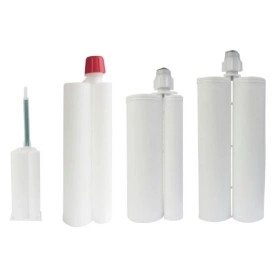
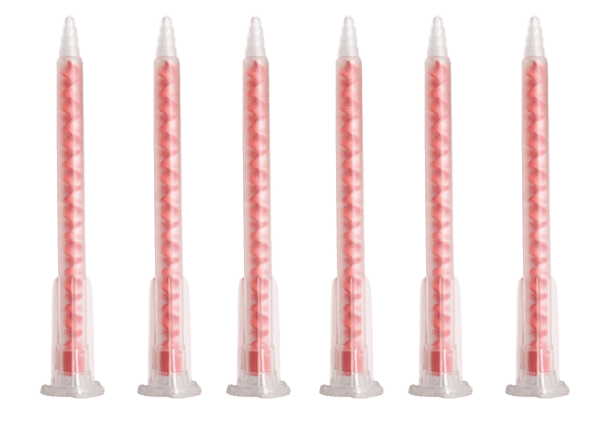
Compact mixing with lower retained adhesive volumeSquare Mixing Nozzle is used when you need two-component dispensing with a shorter mixer body and less adhesive left inside the nozzle after each cycle. This Square Static Mixer Nozzle family supports 50-1500 mL dual cartridges, with multiple connection types, and stepped, straight, or Luer slip outlets for controlled dispensing.
Get a Quick Quote

Key Advantages of Square Mixing Nozzle

Use square mixing nozzles when material waste, nozzle body length, or abrasion resistance from filled adhesives limits your current static mixing setup.
  • Shorter element stack, comparable mix quality: Square channel geometry generates stronger shear gradients and splitting-recombining flow, achieving thorough homogeneity in fewer elements — reducing body length where installation clearance is limited.
  • Lower retained volume reduces waste per cycle: Less adhesive stays inside the nozzle after each shot, directly reducing per-unit material cost on expensive or filled adhesive applications.
  • POM elements resist filled and abrasive adhesives: The open square-channel path gives thermal pastes and particle-loaded compounds less surface area to accumulate on, extending element service life.
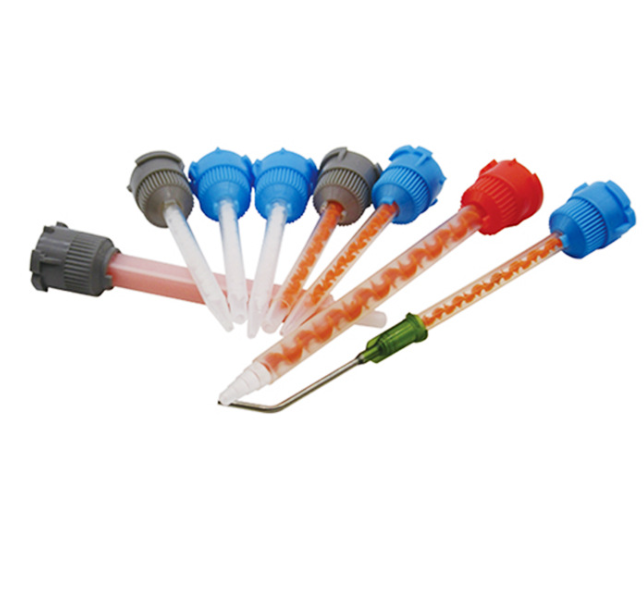
  • Multiple connection types for broad cartridge coverage: Bayonet, bell-mouth, and threaded options cover 50–1500 mL dual cartridges across 1:1, 2:1, 4:1, and 10:1 systems.
Request For Our Latest Price

Available Square Mixing Nozzle Configurations

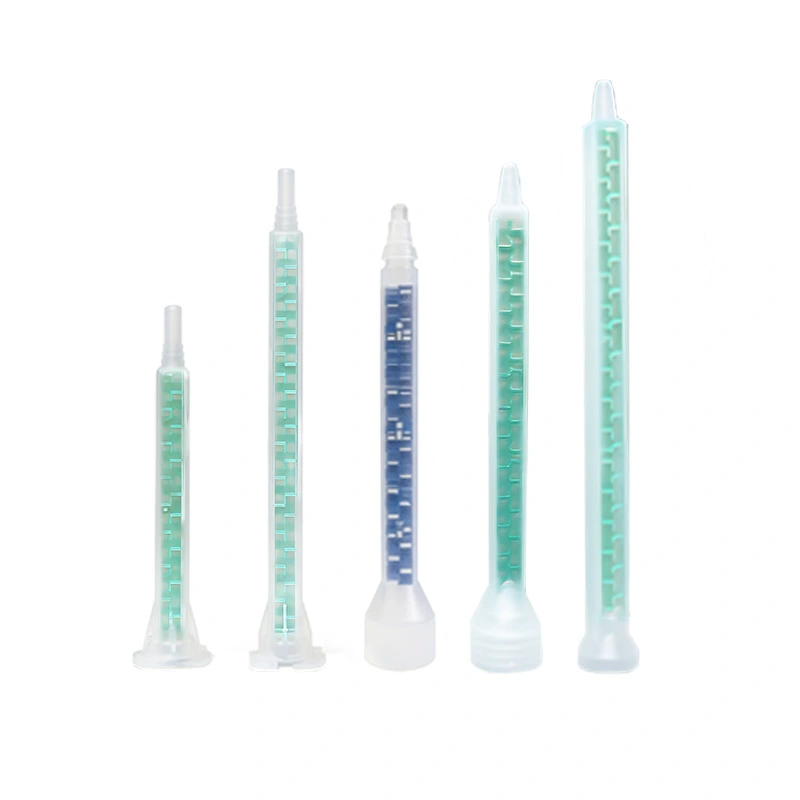
Square Mixing Nozzle configurations cover multiple connection styles, 16-32 element designs, 5.3-8.7 mm internal diameters, and compact body lengths around 83-188 mm. The 5.3 mm range typically suits more controlled output and tighter equipment layouts, while 8.7 mm designs are often chosen when material volume or cartridge size increases.

No. Part No. Elements I.D.(mm) L(mm) O.D.(mm) A(mm) Inner-core Color
A4 PMF6.0-16 16 5.3 83 7.5 1.8 Green/ Gold/pink/white
A6 PMF6.0-24 24 5.3 115 7.5 1.8 Green
B1 PMF06-24 24 5.3 127 7.5 1.8 Green
B2 PMF08-24 24 8.7 150 12 3.5 Green
B3 PMF08-24T 24 8.7 165 12 3.5 Green
B4 PMF08-32 32 8.7 188 12 3.5 Green
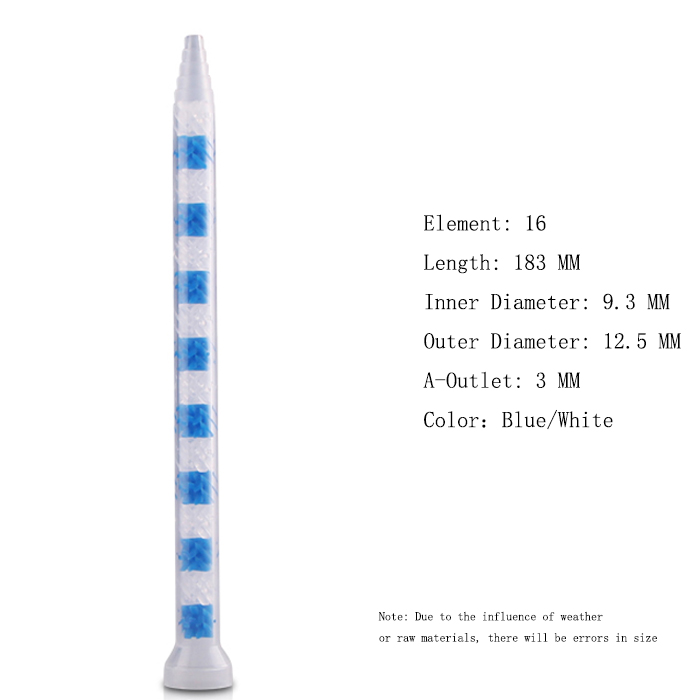
B65 MBQ08-18 18 8.7 143 12 3.5 Blue

How to Choose the Right Square Mixing Nozzle

  • Cartridge size and ratio: Confirm the Square Mixing Nozzle matches 50-1500 mL dual cartridges and 1:1, 2:1, 4:1, or 10:1 systems before selection.
  • Internal diameter and body length: Smaller IDs and shorter bodies usually suit tighter layouts, while larger IDs may fit higher-volume dispensing conditions.
  • Element count: Lower counts often suit shorter mixing paths, while 24-32 elements are usually checked first when mixing distance needs more attention.
  • Connection and outlet type: Choose the cartridge interface first, then select stepped, straight, or Luer slip output from the required bead control and downstream setup.

Customization Options for Square Mixing Nozzle

Standard Square Mixing Nozzle models cover many two-component dispensing tasks, but some processes need a different body size, connection format, outlet style, or supply format. When cartridge fit and dispensing conditions fall outside the stock range, product-level changes can reduce compromise.

OEM Production

OEM Production

Manufacture to customer drawings covering body dimensions, internal diameter, element count, connection type, outlet style, and confirmed construction details.

ODM Development

ODM Development

Evaluate nozzle geometry around material viscosity, mix ratio, retained adhesive target, cartridge interface, and the intended dispensing condition.

Structural & Interface Customization

Structural & Interface Customization

Adjust body length, internal diameter, element count, connection format, or outlet structure to match cartridge standards and equipment.

Branding & Packaging

Branding & Packaging

Provide custom labeling, color identification, or packaging format for private-label distribution, internal sorting, or OEM channel requirements.

Excellent Performance in Industrial Applications

Square Mixing Nozzle fits processes where compact body length, lower retained adhesive, and consistent two-component mixing all affect material cost and application control. It is commonly used in automotive assembly, electronics encapsulation, and optical communication work where waste reduction and stable dispensing both matter.

Close-up of a dual-cartridge caulking gun equipped with a long, translucent static mixing nozzle for dispensing and automatically mixing two-component epoxy adhesive. The nozzle is attached to the cartridge, ready for application in a workshop setting

Automotive Assembly and EV Battery Production

EV battery module potting with thermal conductive adhesives and structural bonding of lightweight body panels require consistent mix ratios across high cycle volumes. Thermal pastes and filled epoxies accumulate inside standard helical elements over extended runs, increasing flow restriction and degrading mix consistency across shifts. The square channel geometry gives filled materials a lower-accumulation flow path, maintaining stable output through full production cycles. For ADAS sensor sealing and powertrain component gasketing, the lower retained volume per shot reduces material cost on high-cycle automated lines.

Send Inquiry Now
Close-up of an automated dispensing nozzle extruding white material onto a metallic electronic component during precision manufacturing process

Electronics and Semiconductor Encapsulation

Thermal conductive adhesives for chip and module heat dissipation, insulating encapsulants for sensitive component protection, and fine-line dispensing on high-density PCBs all require thorough mix homogeneity in a compact nozzle body. If the nozzle body is too long for the dispensing fixture, clearance becomes the limiting factor rather than mix quality. The shorter element stack of square mixing nozzles addresses this constraint without compromising homogeneity, allowing the same nozzle family to cover both fine-pitch and larger-area dispensing tasks on the same production line.

Send Inquiry Now
A person wearing gloves applying a mixed two-part epoxy adhesive bead from a dual-cartridge gun with a green static mixing nozzle onto a joint between two panels

Optical Communications and Connector Dispensing

Fiber optic connector bonding with low-residue epoxies and optical device sealing against environmental ingress require precise ratio control and minimal adhesive waste per shot. Excess retained material in the nozzle after each shot raises the risk of ratio inconsistency at the start of the next cycle and increases per-unit cost across repeated connector assembly. The lower retained volume of square mixing nozzles reduces this inter-cycle variation, supporting more consistent curing results where deposit size and placement accuracy are both tightly controlled.

Send Inquiry Now

Frequently Asked Questions About Square Mixing Nozzle

How does a square mixing nozzle differ from a standard helical static mixing nozzle?

Square mixing nozzles achieve comparable homogeneity in a shorter element stack by generating stronger radial shear and boundary layer disturbance than helical elements, while leaving less retained material inside the nozzle after each shot. For standard non-filled adhesives at moderate viscosity, helical nozzles are a reliable and familiar choice. When nozzle body length, material waste, or abrasion from filled adhesives is a process concern, square mixing nozzles are typically the better fit — confirm element count against your material viscosity before switching.

What cartridge sizes and mix ratios does the square mixing nozzle support?

+

Can square mixing nozzles handle filled or abrasive adhesives like thermal pastes and silver epoxies?

+

Why is my square mixing nozzle producing streaking or inconsistent mix output?

+

When should I choose a square static mixing nozzle over other static mixer types for two-component dispensing?

+

Learn More About Square Mixing Nozzle

Our blog is designed to help you deepen your knowledge of fluid dispensing processes, optimize your production line, and select the best components for your specific challenges. Explore articles that connect industry insights with practical solutions.

View Related Blog →