
A static mixer that fits the cartridge can still create excessive backpressure, waste material, or leave an unevenly mixed bead. Use this test plan to evaluate a mixer with your actual filled epoxy or urethane, process temperature, and dispensing rate.
Start With the Adhesive’s Operating Limits
Before you compare mixer models, review the current technical data sheet for both components. Record the A:B ratio and whether it is specified by volume or weight, viscosity at the application temperature, pot life, allowable working time, and any mixer or dispensing accessories recommended by the adhesive supplier.
If the formulation contains filler, ask for the filler type, loading, and particle-size information when it is available. Do not assume that every filled adhesive is abrasive or shear-sensitive; those properties depend on the formulation. Before changing mixer geometry, operating pressure, or dispense rate, confirm that the proposed change is permitted by the material and equipment suppliers.
Keep the material lot, temperature, cartridge or supply configuration, and test method consistent when you compare candidates. Otherwise, you may attribute a change in flow or cure to the mixer when another process variable has changed.
Confirm the Mixer Is Intended for Your Dispensing System
First identify whether you are using a dual-cartridge system or a meter-mix dispensing machine. For many cartridge adhesives, the material supplier specifies an approved mixer; start with that recommendation and ask before substituting another design. A metering system may require application-specific validation because the actual flow rate, pressure capability, and operating cycle affect mixer performance.
Check the inlet connection, retaining method, seal contact, internal diameter, element geometry, mixer length, outlet style, and internal hold-up volume. A bayonet connection and a bell-mouth connection are designed for different cartridge interfaces, so a similar-looking mixer is not necessarily interchangeable. Confirm the drawing and physical fit before you begin a performance trial.
Do not assume that a higher element count automatically produces a better result. Element geometry, bore, and length work together: a more intensive or longer mixing path may improve blending in one application but can also increase pressure drop and the amount of material retained in the mixer.
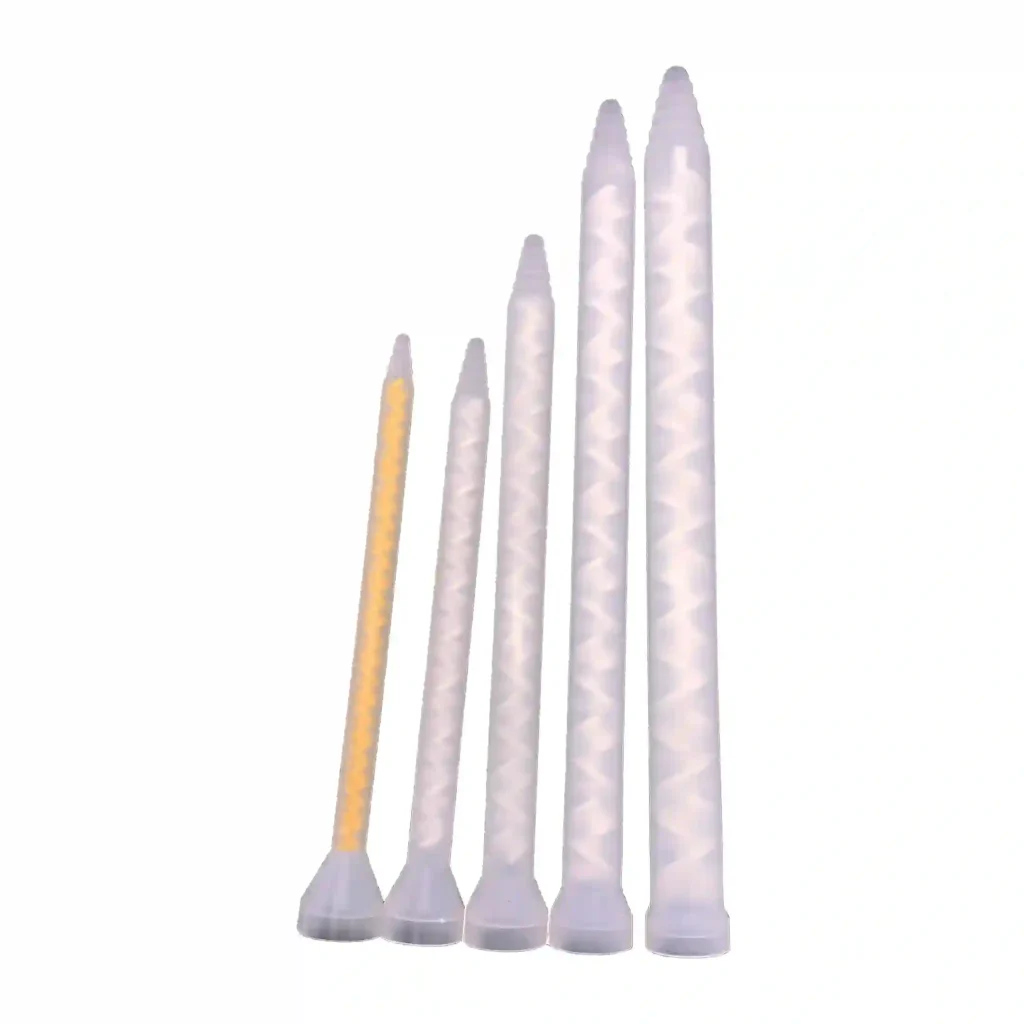
Run a Controlled Dispensing Trial
Prepare One Consistent Setup
Use the same adhesive lot, cartridge or supply system, process temperature, and equipment settings for each candidate. Record the material and room temperatures, the time since the cartridge or supply was opened, the specified ratio, and the mixer model. Inspect the cartridge outlet and mixer connection for damage before installation.
Check component flow separately only when the adhesive and equipment manufacturers permit that procedure. Install the candidate mixer, purge startup material using the approved method, and do not treat an unpurged first sample as a valid mixing result.
Test Across the Required Operating Range
Dispense samples at the lowest, normal, and highest flow rates that your process actually requires, while staying within the equipment’s rated limits. If your line includes pauses, also test a restart after the longest planned interruption. Observe the beginning and steady portion of each dispense rather than judging the mixer from one short bead.
Record the drive setting or pressure, dispense time, bead appearance, interruptions, visible streaks, leakage, and any change in the way the equipment responds. Repeat the same sequence with the next candidate while keeping the other variables unchanged.
Change One Variable at a Time
If a candidate performs poorly, change only one factor in the next comparison—for example, bore, element geometry, or length. Do not change the mixer, temperature, and dispense rate together, because you will not know which change affected the result. For reactive adhesives, replace a mixer when material has begun to cure inside it; do not reuse a blocked or partly cured mixer unless the supplier explicitly permits it.
Evaluate Three Outcomes Separately
Mixing and Cure Quality
Look for visible streaking, color variation, or other signs that the components are not blending consistently. These observations are useful screening checks, but a uniform-looking bead is not proof of correct cure or bond performance. Use the adhesive manufacturer’s specified method for cure, hardness, or bond testing, as appropriate for the application.
If streaking remains at different flow rates, investigate the mixer configuration, the delivered ratio, and the condition of the material before changing hardware again. A mixer cannot correct a metering problem upstream.
Flow Resistance and Equipment Behavior
Compare the pressure or dispensing force needed to maintain a similar flow rate with each candidate. Watch for sudden pressure increases, interrupted discharge, pack deformation, leakage, or abnormal pulsation. These signs may indicate a blocked or overly restrictive flow path, but they can also point to a damaged cartridge or equipment issue.
Never exceed the cartridge, mixer, or applicator pressure rating to make a candidate work. If the required flow cannot be achieved within the approved operating range, reject the configuration and review the mixer and system compatibility.
Waste and Changeover Losses
Measure the material discarded during startup, the volume retained in the spent mixer, and how often the nozzle needs replacement. If your process uses short shots, a small difference in retained volume may have a meaningful effect over a shift. Compare waste only after each candidate has met the required mixing and cure criteria.
Create a Mixer Approval Record
Use a simple worksheet so another operator can reproduce the approved setup. Include the candidate model, inlet and outlet interface, adhesive name and lot, ratio and basis, process temperature, dispense rate, equipment setting, bead observations, cure result, startup purge, retained waste, and operator comments.
Set pass/fail criteria before the trial. If a limit comes from a customer specification, adhesive supplier, or equipment manufacturer, identify that source. Do not present one application’s pressure, element count, or cure threshold as a universal industry rule. Keep a photograph of the installed mixer and accepted sample with the record.
FAQs About Static Mixer Testing
Will More Mixer Elements Always Improve Epoxy Curing?
No. More elements may improve blending in a particular formulation, but they can also increase flow resistance and retained material. You need to test the mixer with the actual adhesive, ratio, temperature, and dispense rate, then verify cure using the supplier’s acceptance method.
Can You Use One Static Mixer for Different Filled Adhesives?
Do not assume so, even if the inlet connection is the same. Different formulations can have different viscosities, filler characteristics, ratios, and working times. Verify compatibility and mixing performance separately for each adhesive.
Should You Test a Mixer at Only the Normal Production Rate?
No. You should also check the lowest and highest flow rates your process requires, plus restart behavior if pauses occur in production. A mixer that works at one steady rate may create excessive resistance or inconsistent mixing at another.
What Information Should You Send for a Mixer Recommendation?
Provide the adhesive technical data sheet, A:B ratio and basis, viscosity at use temperature, filler information if available, cartridge or mixer-inlet drawing, target flow rate, outlet requirement, equipment model, and a description of any current failure.
Final Thoughts
A mixer should be approved on demonstrated performance, not element count or length alone. A reliable decision combines interface fit, stable flow, acceptable waste, and supplier-approved mixing and cure results across your actual operating range. Btektech supplies static mixing nozzles and related dispensing components for two-component adhesives. Visit Btektech and review the static mixing nozzle range when you need to compare inlet, bore, element, and outlet configurations.