
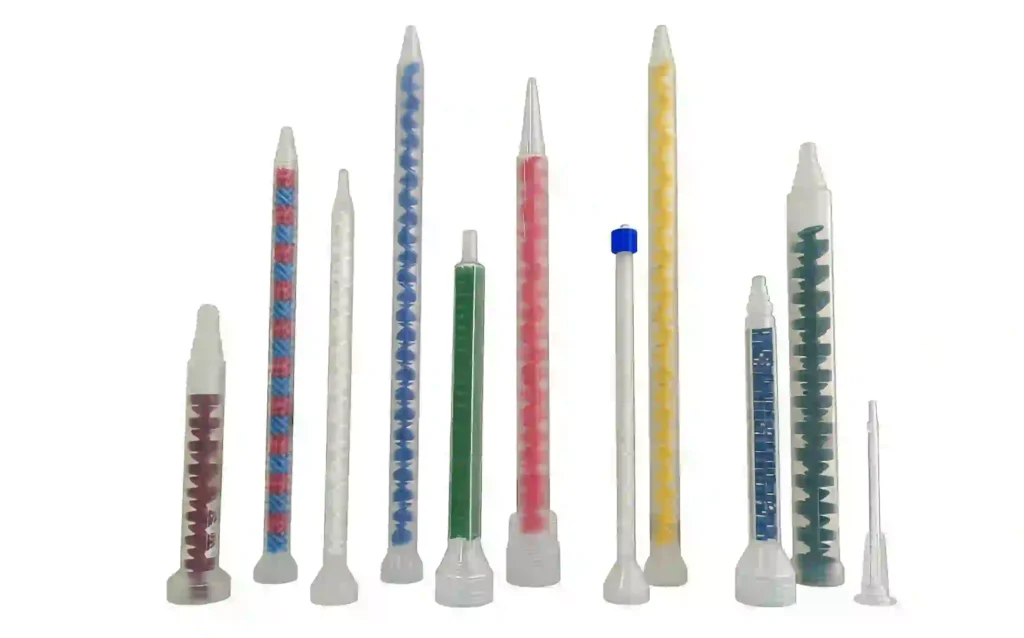
When using two-component epoxy adhesives, do you face the following problem: inconsistent curing results despite the same formula—sometimes ideal, sometimes incomplete curing, resulting in bubbling and other issues?
Besides issues with the adhesive itself, errors in the mixing process are also crucial, especially in the selection of epoxy mixing nozzles and their materials. These nozzles are not merely channels for delivering adhesive; they are key factors determining whether two-component adhesives can be thoroughly and evenly mixed. If the epoxy mixing nozzle material is incompatible with your application, it can affect chemical resistance, mechanical strength, lifespan, and the overall reliability of the dispensing process.
When choosing epoxy mixing nozzles, you need to pay attention not only to the design of the internal components (e.g., spiral, square, and cross), but also to the differences between the different materials.
Btektech.com will systematically analyze the differences and characteristics of these materials to help you find a balance between performance, cost, and reliability, and find the mixing nozzle best suited for your actual operating conditions.
Why Material Selection Matters in Epoxy Mixing Nozzles
In two-component dispensing systems, although epoxy mixing nozzles are often considered disposable consumables, they are actually critical components affecting the uniformity of two-component adhesive mixing, the stability of dispensing, and the continuity of production. Inappropriate material selection can lead to uneven mixing, incomplete curing, or even unexpected downtime during dispensing.
Evaluating the suitability of the mixing nozzle material is a crucial step in ensuring production efficiency and product consistency, primarily based on the following core considerations:
- Chemical Compatibility: Epoxy resins, hardeners, and additives can be chemically aggressive. If the nozzle material is not compatible, it may soften, swell, crack, or degrade during use.
- Mechanical Strength and Durability: Dispensing pressure, flow rate, and viscosity all place mechanical stress on the nozzle. Insufficient strength can lead to deformation or breakage, especially in high-pressure or automated systems.
- Impact on Mixing Performance and Service Life: Material rigidity and dimensional stability affect how well the internal mixing elements maintain their shape. This directly influences mixing consistency and determines how long a nozzle can be used before performance declines.
Common Materials Used in Epoxy Mixing Nozzles
Epoxy Mixing Nozzles are typically made from a variety of engineering thermoplastics. No single material is suitable for all applications; each material has its own strengths and weaknesses in terms of chemical resistance, mechanical strength, dimensional stability, and cost. Below are the core properties and applications of some commonly used materials:
Polypropylene (PP): An Economical and Versatile Choice
PP is one of the most common materials, widely used in standard operations such as manual dispensing or short-cycle production, especially suitable for applications sensitive to single-use costs.
Advantages
- Good chemical compatibility with many common epoxy resin systems
- Lightweight and easy to process
- Low cost, suitable for single use
- Sufficient structural stability under low to medium pressureLimitations
- Relatively low rigidity, may exhibit slight deformation under high pressure
- Limited dimensional stability under prolonged high-temperature environments
Nylon (PA): A Balance of Strength and Abrasion Resistance
PA have superior mechanical properties compared to PP, and can more reliably withstand higher dispensing pressures.
Advantages
- Higher rigidity
- Stronger resistance to deformation
- Better abrasion resistanceLimitations
- Higher price
- Higher hygroscopicity, storage and usage conditions should be considered in extreme humidity environments.
Polyoxymethylene (POM): A Choice for High Precision and Stability
POM is an engineering plastic with high rigidity and high dimensional stability, offering significant advantages in precision dispensing applications.
Advantages
- Low coefficient of friction
- Excellent wear resistance
- Good long-term dimensional stabilityLimitations
- Higher price
- Relatively difficult to process
Engineering Decision Framework: How to Select the Right Material
After understanding common materials, you can conduct a systematic evaluation through the following four steps:
Step 1 – Evaluate the Chemical Properties of the Resin System
The first step requires a comprehensive understanding of the epoxy formulation used, including whether it contains solvents or reactive diluents, the chemical reactivity of the cured system, and whether it contains fillers or a high proportion of inorganic particles.
- Solvents or reactive diluents may cause materials with low chemical resistance to soften, swell, or microcrack;
- Highly chemically active systems will accelerate material aging;
- Filler-type resins will increase internal wear and place higher demands on nozzle rigidity.
By analyzing these factors, you can determine which type of material is best suited for the current resin system in terms of chemical stability and abrasion resistance.
Step 2 – Evaluating Process Parameters and Operating Environment
The second step involves evaluating material suitability based on actual production conditions, including dispensing pressure, resin viscosity, operating temperature, whether the operation is automated, and the required mixing precision.
- High viscosity or high pressure systems can exert shear and deformation stress on the nozzle’s internal structure;
- High temperatures or exothermic curing can cause material softening.
Automated production requires long-term stable operation and precise mixing. By comprehensively considering these process parameters, materials that meet the requirements in terms of mechanical strength, dimensional stability, and heat resistance can be selected.
Step 3 – Define Usage Cycle and Production Line Scale
The third step is to define the nozzle’s usage cycle and the production line scale.
- For single-use or short-cycle, low-intensity applications, the requirements for material rigidity and durability can be appropriately reduced, thus gaining a cost advantage.
- For multi-cycle or medium-frequency use scenarios, both strength and wear resistance need to be considered. High-volume, continuous, automated production lines have the highest requirements for material stability, as nozzle failure can lead to downtime, production line rework, or even product scrap.
Defining the usage cycle and production line scale helps match material performance requirements with actual production risks.
Step 4 – Balancing Material Costs and Downtime Risks
Finally, a balance needs to be struck between material costs and the risk of production downtime. On high-cycle automated production lines, the downtime costs, rework risks, and production line fluctuations caused by a single nozzle failure often far outweigh the differences in unit prices of different materials.
The core principle of engineering selection is to prioritize system stability and reliability, and then consider cost optimization on that basis.
The correct decision-making logic should be: select the material with the lowest overall risk and best ensuring mixing consistency under the current resin system, process conditions, and production requirements, rather than simply pursuing the lowest price or the most robust material.
Application-Based Recommendation Matrix
In practical engineering applications, the optimal choice of mixed nozzle materials often depends on the specific application type, not just the budget level. Below is a table of typical application scenarios and recommended materials prepared by Btektech:
| Application | Core Features | Materials | Explanation |
| Electronics Encapsulation | High-precision mixing, low voids, may contain fillers | POM or PA | Electronics encapsulation requires extremely uniform mixing and dimensional stability. POM’s high rigidity and geometric retention help maintain consistent shear distribution; PA also provides good mechanical stability in high-viscosity filler systems. |
| Structural Bonding | Medium-to-high viscosity, high-strength requirements, batch production | PA or POM | Structural adhesives often involve higher dispensing pressures. High-modulus materials reduce internal mixing element deformation, ensuring consistent curing strength. |
| Automotive Assembly | Continuous automated production, high cycle rate | POM or PA | Automotive production lines have fast cycles and high downtime costs. Materials must offer long-term dimensional stability and wear resistance. High-rigidity materials help reduce quality risks caused by mixing fluctuations. |
| Industrial Repair | Manual operation, low-frequency use, harsh environment | PP | Repair applications emphasize convenience and cost control. PP provides sufficient stability for most standard epoxy systems; PE offers flexibility and impact resistance in environments prone to accidental shocks. |
| General Manual Dispensing | Medium-to-low pressure, intermittent use | PP | Cost-effective and suitable for most standard epoxy systems. Ensuring chemical compatibility makes PP an economical choice. |
| High-Viscosity Filled Systems | High viscosity, high backpressure, significant wear | POM or PA | Filled systems increase wear and mechanical load. High-rigidity and wear-resistant materials are needed to maintain long-term mixing precision. |
Conclusion
While epoxy mixing nozzles are small components, their material selection is a crucial, albeit often overlooked, factor in the success of dispensing processes. They are not simply flow channels, but core functional components that ensure chemical compatibility, withstand mechanical stress, and maintain mixing precision.
From economical PP to robust PA, and precise POM, each material represents a balance between performance, durability, and cost. The essence of selection is not about finding the “most expensive” or “strongest” material, but rather seeking a solution that best matches your specific resin formulation, process parameters, and production requirements.
As a professional manufacturer of dispensing solutions, Btektech.com offers a full range of mixing nozzles. Contact us to help you precisely match the most suitable mixing nozzle and optimize your dispensing process and production efficiency.