
Cartridge Selection Guide for Two-Component Epoxy, Silicone, and Polyurea
Introduction
When selecting adhesive cartridges, the right choice depends less on the cartridge alone and more on the material being dispensed. Epoxy, silicone, and polyurea differ significantly in mix ratio, viscosity, reaction behavior, and dispensing characteristics—and as a result, the cartridge selection logic also differs for each material family.
Rather than starting with cartridge features such as chamber design or material construction, an effective selection process begins with understanding the adhesive formulation. This guide explains the main material-driven factors to check first and provides a clear framework for matching cartridge structure to application requirements.
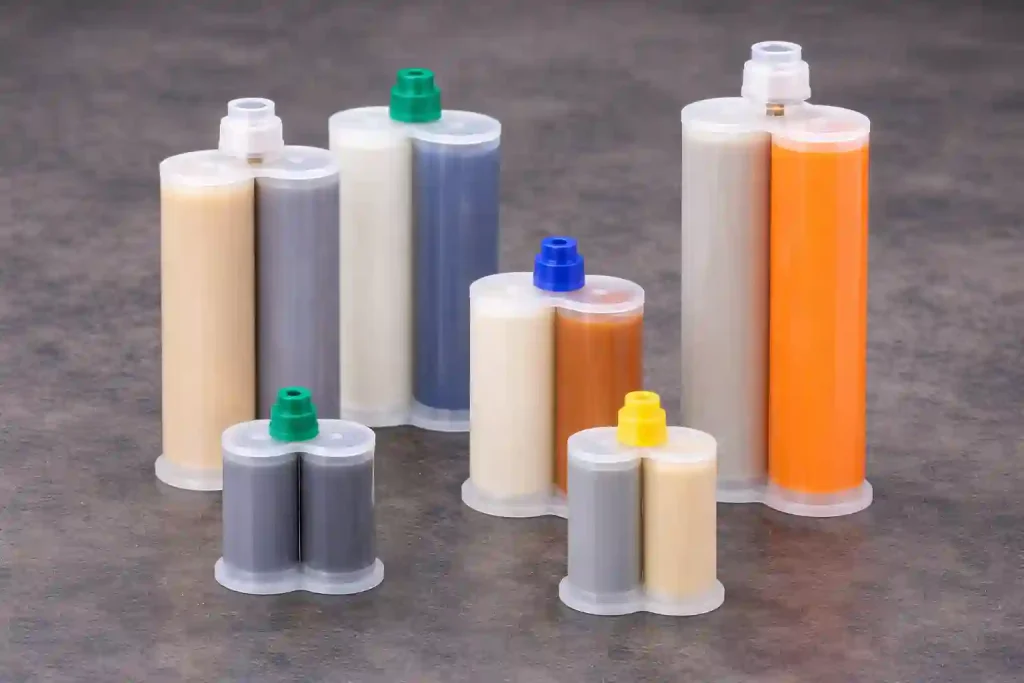
Material Differences: Epoxy vs. Silicone vs. Polyurea
Epoxy: ratios vary widely by formulation, and viscosity can range from low to highly filled. Selection usually starts with ratio and filler-related dispensing resistance.
Silicone: often higher in viscosity and more sensitive to sealing or contamination issues. Selection should pay more attention to ratio stability and clean dispensing.
Polyurea: reaction speed is typically faster, and flow behavior may be more time-sensitive. Selection should place more emphasis on sealing stability, ratio accuracy, and dispensing speed tolerance.
Mix Ratio
Intwo-component cartridge selection, the mix ratio is a primary determinant of the cartridge structure. The correct approach is not to select a cartridge first and then check if the ratio fits, but to begin with the volume ratio specified in the material’s Technical Data Sheet (TDS) and identify a cartridge that provides the corresponding chamber geometry.
Different material families have distinct formulation characteristics that influence how ratio accuracy should be prioritized:
- Epoxy: Epoxy formulations cover a wide range of mix ratios, from 1:1 and 2:1 to 4:1, 10:1, or even higher. Given this diversity, verifying that the cartridge’s fixed ratio matches the TDS specification is typically the first and most critical selection step.
- Silicone: Silicone systems often concentrate around a smaller set of standard ratios, most commonly 1:1 and 10:1. However, the required ratio must still be sourced directly from the material formulation. A 1:1 ratio is common in many general dispensing and sealing applications, while 10:1 systems are also used in formulations that require a much smaller activator volume.
- Polyurea: For faster-reacting systems such as certain polyurea formulations, ratio accuracy and reliable component separation become especially important. In these cases, the precision of the cartridge’s fixed ratio—often 1:1 or 2:1—helps maintain more consistent curing behavior, as even small deviations may affect reaction speed and final properties.
Viscosity and Dispensing Resistance
Material viscosity and formulation characteristics—such as filler content or rheology—directly influence dispensing resistance and, in turn, shape cartridge selection priorities. Rather than prescribing a specific cartridge size, the focus should be on how the material’s physical behavior aligns with the dispensing system’s ability to manage flow and sealing.
- Epoxy: Epoxy formulations span a broad viscosity range, from low-viscosity potting compounds to highly filled, paste-like systems. For lower-viscosity epoxies, the emphasis is on maintaining clean component separation and consistent flow. As viscosity increases, the dispensing system must accommodate higher extrusion forces, which may favor configurations that reduce flow resistance—such as larger internal cross-sections or optimized chamber geometry—without compromising ratio accuracy.
- Silicone: Silicone materials, particularly those used in industrial or electronic applications, are often characterized by high consistency and significant flow resistance. In such cases, the selection logic prioritizes reducing backpressure and ensuring stable extrusion. This may influence choices around chamber volume and aspect ratio, as overly restrictive flow paths can lead to uneven dispensing or excessive operator effort. Additionally, high-viscosity silicones place greater demands on cartridge structural integrity to withstand elevated dispensing pressures.
- Polyurea: Polyurea formulations typically exhibit lower viscosity and good flowability, which allows for more flexibility in system configuration. However, lower-viscosity materials introduce different considerations, primarily around leakage prevention and drip control. The focus for such systems is on sealing integrity and precise start-stop behavior, ensuring that the dispensing setup minimizes unwanted flow during idle periods.
Importantly, filled epoxy systems, high-consistency silicones, and fast-reacting polyurea formulations may each create distinctly different dispensing behaviors—even when housed in cartridges of identical volume. A material-led selection approach therefore evaluates viscosity, filler content, and flow resistance as primary variables, rather than starting from a predefined cartridge size.
Material Compatibility and Sealing Considerations
Selection of a two-component cartridge must account for how the material system interacts with the cartridge structure and accessories. Cartridge compatibility considerations are not one-size-fits-all; instead, they depend on whether the formulation is chemically aggressive, sensitive to contamination, or prone to leakage under pressure. Different material families may place emphasis on different aspects of compatibility and sealing.
- Epoxy: Epoxy formulations generally exhibit broad compatibility with common cartridge materials, making chemical interaction less frequently the primary selection driver. Instead, the focus for epoxy systems is often on ensuring the cartridge structure aligns with the specified mix ratio and provides adequate pressure resistance for the intended dispensing application.
- Silicone: For silicone systems, compatibility considerations become more nuanced. Certain silicone types—particularly addition-curing formulations—can be sensitive to specific chemicals or substrates that may interfere with proper curing. In such cases, the emphasis is on maintaining a clean, uncontaminated dispensing environment. Where chemical compatibility is uncertain, cartridge material selection should follow the adhesive supplier’s compatibility guidance rather than relying on general assumptions. Additionally, some silicone formulations are susceptible to moisture uptake, which places greater importance on sealing integrity—such as airtight closures and moisture-resistant features—to preserve material stability before use.
- Polyurea: Polyurea formulations typically react quickly and may be sensitive to moisture or contaminants that could affect reaction consistency. For these systems, compatibility considerations center on ensuring the cartridge provides stable, uninterrupted separation of the two components until the point of mixing. Sealing integrity is particularly important to prevent premature interaction or exposure to ambient conditions. Where application involves rapid-reacting materials, the focus should be on cartridge designs that maintain physical separation and reliable sealing under dispensing pressures.
In all cases, compatibility should be assessed based on the specific material formulation and its documented requirements. When interaction between the material and cartridge components is a concern, cartridge material selection should be guided by the adhesive manufacturer’s recommendations rather than generalized material pairings.
Static Mixer and Dispensing Method Implications
The material formulation influences not only cartridge selection but also the requirements for static mixing and the broader dispensing setup. The focus here is on how material properties—such as viscosity, filler content, and reaction speed—inform decisions around mixer configuration and the type of dispensing support needed.
- Epoxy: Epoxy systems span a wide range of viscosities and pot lives. For higher-viscosity or heavily filled epoxy formulations, flow resistance through the static mixer becomes a more prominent consideration. Such materials may require mixer designs that balance mixing efficiency with manageable pressure drop—for example, by using suitable internal geometry or larger flow passages where appropriate—so that thorough mixing can be achieved without excessive extrusion force. For lower-viscosity epoxies, the emphasis is more on maintaining consistent flow and avoiding unmixed zones.
- Silicone: Silicone materials, particularly high-consistency grades, often generate significant backpressure during dispensing. This characteristic can influence the choice of static mixer geometry, as excessive pressure may lead to inconsistent mixing or increased operator effort. Mixers with optimized flow paths or reduced resistance may be preferred to ensure uniform blending while maintaining manageable dispensing forces.
- Polyurea: Fast-reacting systems such as certain polyurea formulations have limited tolerance for extended dwell time within the static mixer. Once the two components enter the mixer, mixing must be completed and the material dispensed before reaction progression affects flow behavior or cure quality. This places emphasis on mixer selection that balances mixing efficiency with minimized residence time. Additionally, the dispensing method should support consistent output to avoid interruptions that could lead to material curing inside the mixer.
In all cases, the interaction between material viscosity, filler characteristics, and reaction speed shapes the baseline requirements for static mixer geometry and the overall dispensing setup. These considerations are distinct from equipment-specific parameters and serve as the foundation for determining what mixer configuration and dispensing support are appropriate for a given material system.
How to Make an Initial Cartridge Choice for Epoxy, Silicone, and Polyurea
The selection dimensions outlined above—mix ratio, viscosity and dispensing resistance, material compatibility and sealing, and static mixer implications—can be integrated into a straightforward, material-led decision process. To make an initial cartridge choice, follow these four basic steps:
- First, confirm the material’s required mix ratio.
Begin with the Technical Data Sheet (TDS) of the adhesive. The specified volume ratio determines the fundamental cartridge structure needed—whether a standard side-by-side configuration or an asymmetric chamber design. This is the non-negotiable starting point.
- Second, estimate viscosity and dispensing resistance.
Assess whether the material is low-viscosity and free-flowing, or high-viscosity and filled. Higher-viscosity formulations place greater emphasis on reducing flow resistance within the cartridge and mixer, while lower-viscosity materials shift focus toward sealing stability and drip control.
- Third, check whether sealing stability or chemical compatibility is likely to be a concern.
Consider the material’s sensitivity to moisture, contamination, or chemical interaction with cartridge components. For moisture-sensitive or fast-reacting systems, sealing integrity becomes a primary factor. Where compatibility is uncertain, refer to the adhesive manufacturer’s guidance rather than assuming standard material pairings.
- Fourth, review how material behavior may affect mixer choice and dispensing method.
Evaluate the material’s reaction speed and flow characteristics. Faster-reacting formulations require careful attention to mixer dwell time, while higher-viscosity or filled materials may influence mixer geometry preferences. This step ensures that the cartridge and mixer are considered as an integrated system from the outset.
By following these four steps, you can establish a clear, material-driven foundation for cartridge selection—narrowing options based on formulation requirements before considering specific product formats or accessories.
Conclusion
Initial cartridge selection for epoxy, silicone, and polyurea starts with four material-driven checks: mix ratio, viscosity and dispensing resistance, compatibility and sealing considerations, and the implications for static mixer and dispensing method. Once these factors are assessed against the adhesive formulation, users can establish a clearer foundation for judging which cartridge format and setup are appropriate.
By aligning cartridge choice with the specific behavior of the material being dispensed, the selection process becomes more targeted and reliable. For reference on available adhesive cartridge formats, see our cartridge product page.
FAQs about Cartridge Selection for Epoxy, Silicone, and Polyurea
How does adhesive ratio affect cartridge selection?
The mix ratio specified in the material’s Technical Data Sheet (TDS) is the primary determinant of cartridge structure. Ratios close to 1:1 or 2:1 typically work with standard side-by-side cartridges, as the two components have similar volumes and flow characteristics. For ratios such as 4:1, 10:1, or higher, the volume difference between components is substantial; in these cases, coaxial or asymmetric dual-chamber designs may be used to help maintain more stable flow and ratio delivery during dispensing.
Why does viscosity matter when choosing a cartridge?
Viscosity influences how material flows through the cartridge and affects the demands placed on the dispensing setup. Higher-viscosity formulations—such as filled epoxies or high-consistency silicones—may require cartridge configurations that reduce flow resistance, such as larger internal cross-sections or optimized chamber geometry. Lower-viscosity materials shift emphasis toward sealing stability and drip control, as they are more prone to leakage or unwanted flow.
Do epoxy, silicone, and polyurea need different cartridge formats?
The cartridge format is driven by the specific formulation requirements of each material family, not by the material name alone. Epoxy formulations vary widely in ratio and viscosity, so selection depends on the individual product’s TDS. Silicone systems often concentrate around standard ratios but may place additional emphasis on sealing against moisture or contamination. Polyurea formulations typically react quickly and may place greater emphasis on stable component separation and sealing integrity. In all cases, the cartridge format must align with the material’s documented requirements.
How do material properties affect static mixer and dispensing setup?
Material viscosity and reaction speed shape baseline considerations for static mixer selection. Higher-viscosity materials may increase flow resistance, which can influence mixer length or internal geometry to maintain consistent mixing. Faster-reacting materials reduce tolerance for extended dwell time inside the mixer, as prolonged residence can lead to premature curing. Additionally, the dispensing method may need to account for required output stability or extrusion force based on the material’s flow behavior.
Why do some two-component adhesives use side-by-side cartridges while others require coaxial designs?
The key factor is the mix ratio. For ratios close to 1:1 or 2:1, the volumes of components A and B are relatively balanced, and the flow resistance during dispensing is similar. Standard side-by-side cartridges can maintain stable flow in these cases. However, when the ratio reaches 4:1, 10:1, or higher, the volume difference creates significant resistance disparity between the two sides. In side-by-side cartridges, this can lead to uneven flow—the larger-volume component may dispense faster than the smaller-volume component. Coaxial or asymmetric cartridge designs address this by adjusting chamber layout so that ratio delivery remains more stable under dispensing conditions.