
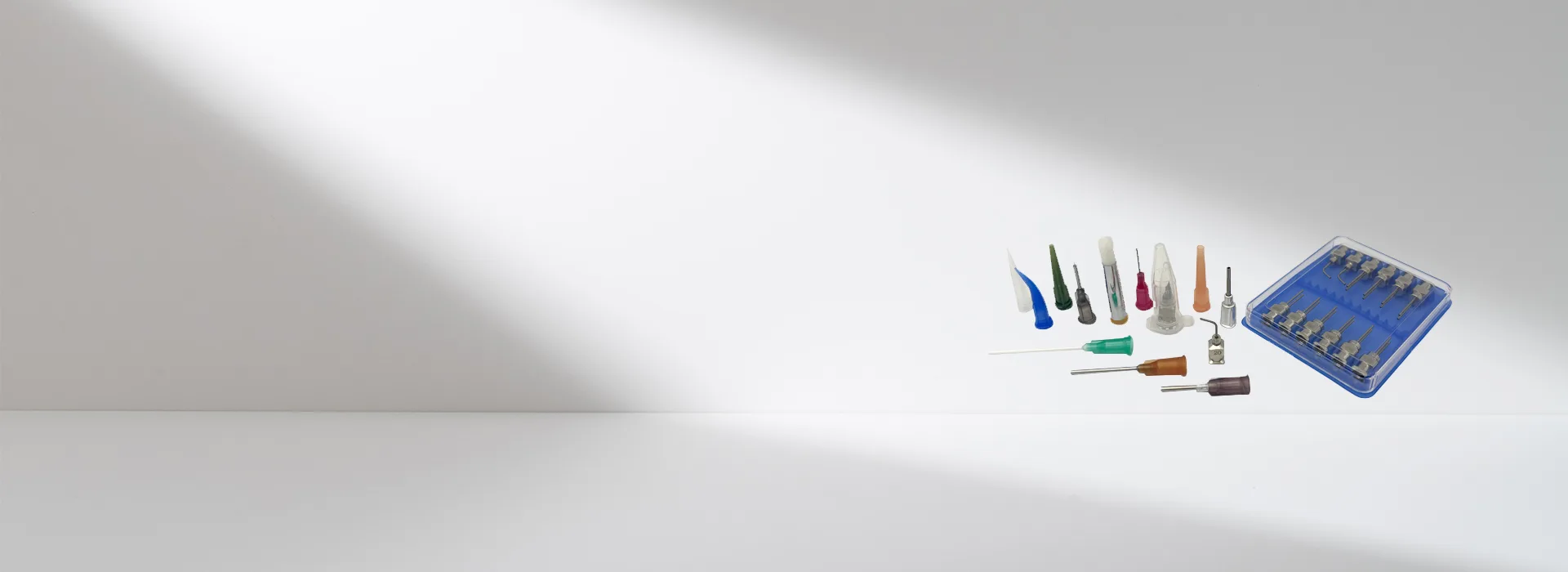
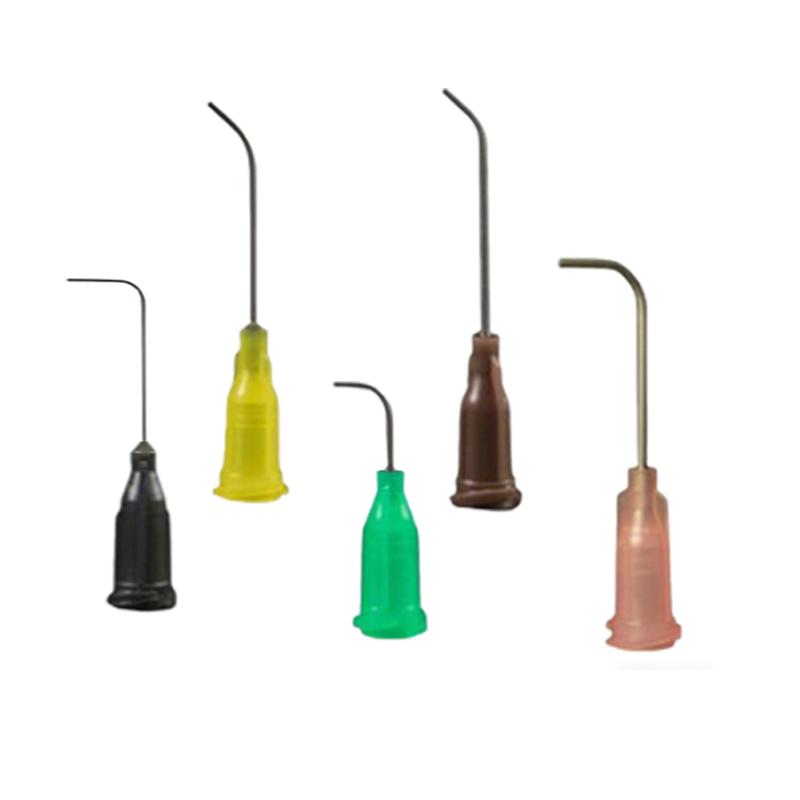
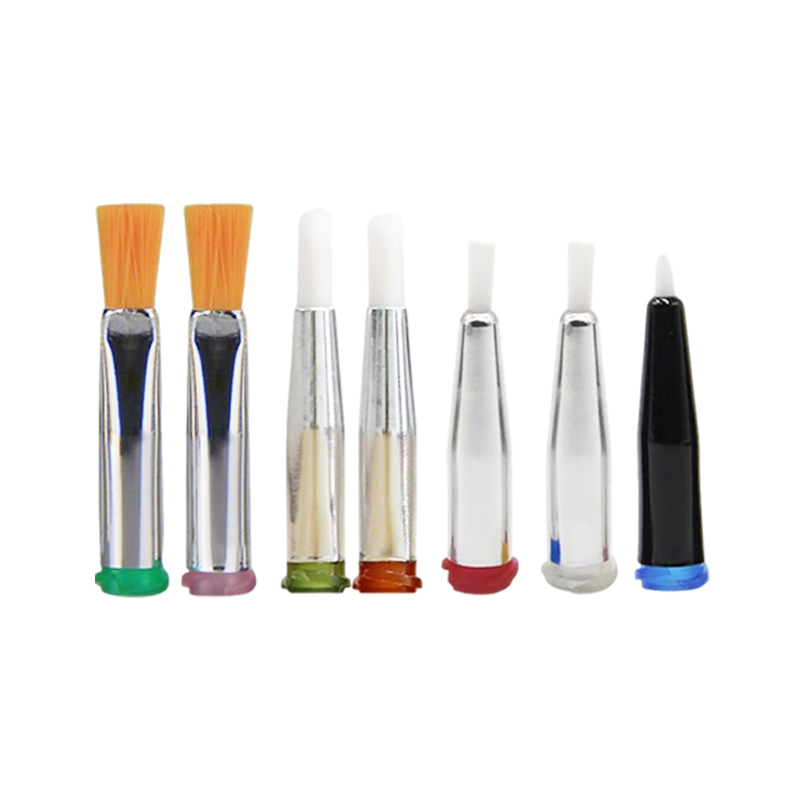

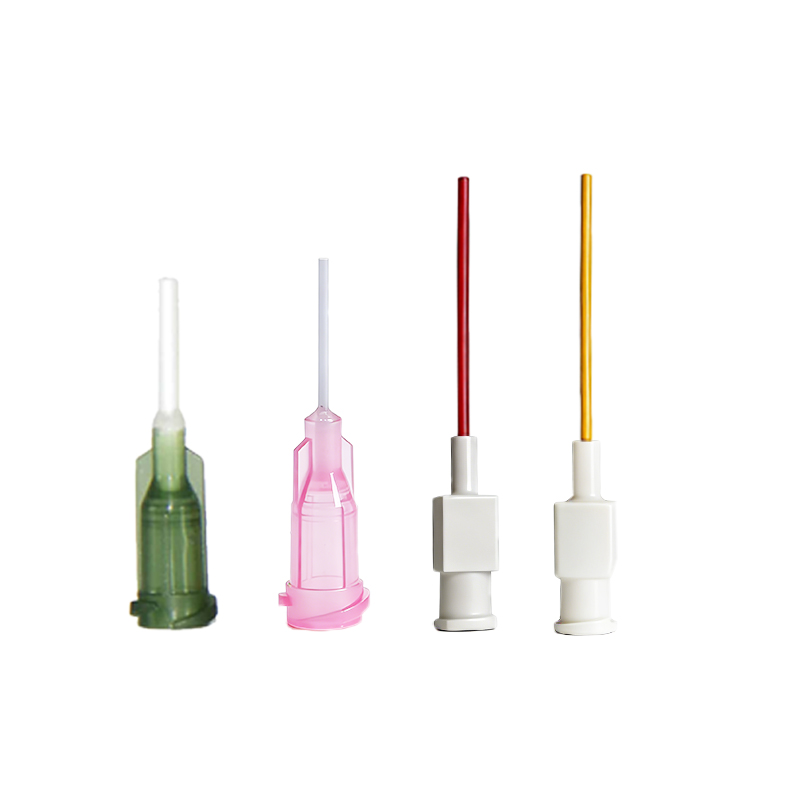
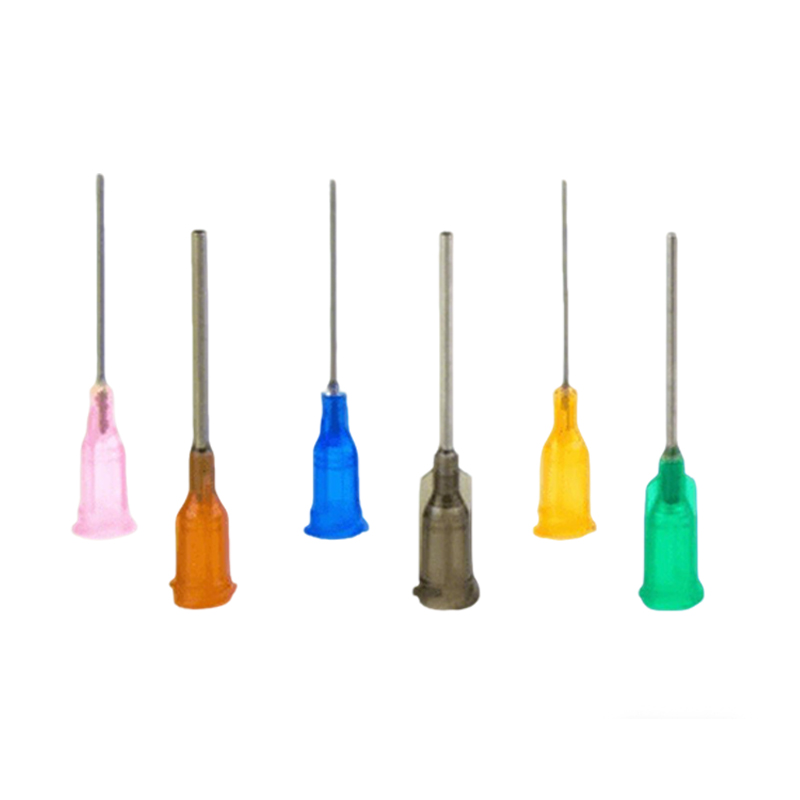
Our adhesive dispensing tips come in various styles, sizes, and materials, and each needle undergoes rigorous quality control checks during manufacturing. Different configurations cater to applications requiring micro-deposition, wide sealing paths, abrasive media, or high-viscosity fluids. Selection depends on viscosity range, bead width, pressure limitations, and device clearance constraints.

Plastic or metal tips with 45°/90° bends enable precise dispensing in hard-to-reach…
Learn More
Rounded-tip needles ensure safe, precise dispensing of adhesives, solvents, and liquids in…
Learn More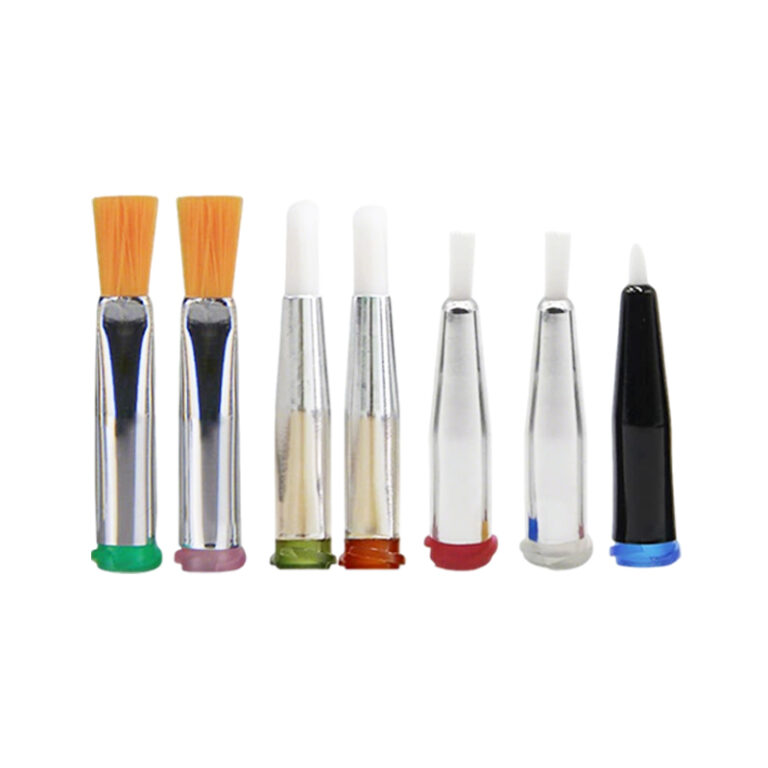
Nylon bristles ensure precise, brush-like application of low-viscosity liquids. Luer-lock compatible, durable,…
Learn More
Precise dispensing in hard-to-reach areas. PP/PE tips resist corrosion, won’t scratch, fit…
Learn More
Elongated oval orifices dispense flat ribbons of pastes, sealants, or epoxy. Made…
Learn More
Stainless-steel cannulae with PTFE lining resist chemicals, enhance flow, prevent clogging, and…
Learn More
Polished, burr-free stainless tips provide precise, contamination-free dispensing of fluids and adhesives.…
Learn More
Polished, burr-free stainless tips provide precise, contamination-free dispensing of fluids and adhesives.…
Learn More
Precision nozzles with a narrowing profile ensure smooth, controlled flow, minimize drips,…
Learn MoreDesign decisions focus on dimensional stability, secure connections, and consistent performance during continuous production use.

The dispensing needle tip undergoes a vibratory finishing process to reduce residual particles and minimize clogging.

A tight connection between the needle and hub enhances structural stability under high operating pressures.

A standard Luer lock base enables quick and stable connection and reduces adhesive leakage during operation.

Some models utilize anti-static and light-shielding materials to protect sensitive or reactive fluids.
At Btektech, every dispensing tip undergoes rigorous quality control checks during manufacturing. We ensure the needles are burr-free by inspecting the smoothness of the cut surface and the presence of burrs. Each batch of products undergoes an airflow test to verify that there is no residual blockage or processing debris in the inner bore. If needed, we also provide, for example, label batch numbers, part numbers, and production dates to enhance process control and traceability.


Our OEM program allows you to customize the needle type, specifications, length, and material to meet your needs. Each dispensing needle is precisely designed to ensure smooth fluid flow and minimal waste. Our ODM program allows you to adjust the structural design based on adhesive viscosity, pressure limits, and equipment constraints. If needed, small-batch validation can be performed before mass production to confirm dimensional matching and dispensing performance.
Detailed specifications, dimensional references, and configuration options for all dispensing tip models available on this page.
DownloadComplete range of dispensing components, covering tips, mixing nozzles, cartridges, guns, and system accessories.
DownloadTechnical articles covering dispensing principles, selection guidance, and process considerations for stable performance.
DownloadBtektech dispensing tips have shown stability in actual production lines. This helps maintain consistent assembly processes over time. The cases below come from partnerships with major manufacturers. They highlight real scenarios in automated and semi-automated setups.

A leading electronics firm uses automated systems for adhesive application in smartphone production. Lines run with quick cycle times to meet high output demands. Uneven dispensing often led to misplaced parts before. This caused more downtime for checks and fixes during long runs. The team tested new tips to address flow changes. They fit existing machines without issues. Production continued smoothly across shifts as a result.

A sporting goods manufacturer required adhesive injection inside multi-layer golf ball molds during automated molding cycles. The bonding cavity is narrow and partially enclosed, limiting access for standard straight dispensing tips. A customized stainless steel tip configuration was adopted to improve access within the confined space. The adjusted format supported controlled adhesive delivery and stable operation throughout continuous automated manufacturing.


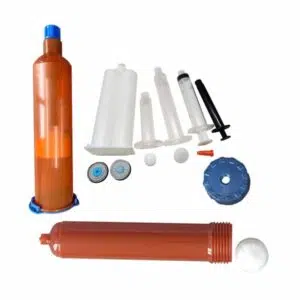
Dispensing is divided into manual dispensing and industrial/automated dispensing systems. The adhesive dispensing tip is the “final exit” of the fluid delivery system.
It does not control the dispensing pressure or time, but it determines the final flow resistance and flow geometry at the exit. If the orifice diameter is off, the coating volume will change. If the exit shape is mismatched, the cross-section of the glue bead will change.
Correctly selecting the needle can maintain the target glue bead width and ensure the consistency and continuity of the dispensing effect.
A dispensing tips consists of three main parts: the inlet interface, the orifice, and the outlet geometry.
The inlet interface can be matched with Luer locks, threaded, or push-fit valves. The orifice controls the volumetric flow rate at a specified pressure; for example, stainless steel can handle abrasive fluids, PP is suitable for low-viscosity adhesives, and PTFE is resistant to chemical corrosion. The outlet shape can be straight, tapered, or elliptical, depending on the shape of the adhesive bead.
Small-diameter orifices increase back pressure; long needles increase pressure drop along their length. Both of these can affect stringing at the end of the cycle.
The optimal choice of dispensing tip depends on several factors, including fluid viscosity, bead width, and dispensing speed. You should select the appropriate dispensing tip based on your specific process flow.
For thin fluids, PTFE-lined Tips can be chosen to disrupt capillary action, the phenomenon where liquids rise or fall automatically in narrow tubes or confined spaces due to surface tension and adhesion between the liquid and solid surfaces.
For high-viscosity pastes or fluids containing particles, Tapered Tips are the best choice because the gradually narrowing design reduces flow resistance, provides lower back pressure, and facilitates the uniform flow of viscous materials, preventing clogging or uneven distribution. For fluids containing particles, the tapered structure provides a larger internal channel, reducing the risk of particle jamming.
For cyanoacrylate adhesives (instant adhesives), the appropriate dispensing tip needs to be selected based on the viscosity. Low-viscosity adhesives flow easily and may cause clogging; the hydrophobicity and chemical inertness of PTFE Tips effectively prevent the adhesive from curing or clogging inside the tip. For medium viscosity adhesives, Tapered Tips reduces flow resistance.
For UV-sensitive adhesives, a UV-blocking dispensing tip must be used. Furthermore, Tapered Tips with added antistatic materials can be used in electrostatic-sensitive applications, ensuring a safe and reliable dispensing process.
Use Tapered Tips or dispensing tips with ≥0.6 mm inner diameter for high-viscosity adhesives. Avoid small diameters that increase backpressure or cause clogging. Keep needle length short to reduce pressure loss. Conduct small-scale tests to confirm flow and bead consistency before mass production.
No, metal dispensing tips may scratch or indent soft surfaces. It is recommended to use Flexible Tips, whose soft walls absorb contact force, maintain consistent gap pressure, prevent damage to the substrate surface, and ensure accurate dispensing positioning.
Yes, use black or UV-blocking dispensing tips to prevent premature curing at the outlet. Transparent or standard metal tips risk localized pre-cure. Minimize post-dispense exposure and assess environmental UV sources.
Luer lock dispensing tips only fit syringes with ISO 594-compliant luer interfaces. Non-standard interfaces may leak. Confirm luer lock or luer slip type, and perform pressure testing before production.
Dispensing tips can be customized in terms of specifications, length, outlet shape, and material type. Materials include stainless steel, PP, PTFE, etc., with different materials having varying temperature and corrosion resistance. You can contact our professional team to provide the viscosity range, working pressure, target bead width, and interface type (e.g., luer lock). It is recommended to conduct sample verification first to confirm the flow rate and equipment compatibility.