
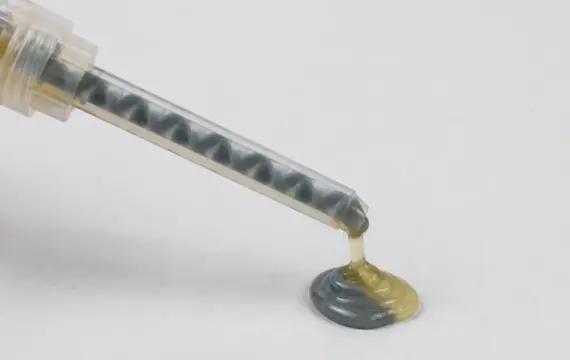
Epoxy waste with mixing nozzles tends to fall into a few reasons: purging too much before application, dispensing more than the job requires, misjudging pot life and letting unused material cure in the pause, and cutting applications short because the mix ratio wasn’t right from the start.
These factors can increase adhesive consumption, material loss, and unnecessary production costs during two-component dispensing processes. This blog will subsequently propose solutions to reduce epoxy waste based on these reasons.
Calculate Epoxy Volume Before Dispensing
Dispensing more epoxy than the joint actually requires is one of the most direct causes of adhesive waste. Excess material squeezed out during assembly or left unused on the surface increases both material consumption and cleanup time.
For repeatable applications such as gasketing, frame bonding, edge sealing, or potting, estimate the required adhesive volume before dispensing begins. Bead diameter, joint length, and bond gap dimensions are usually sufficient for calculating approximate material usage. Establishing a consistent dispense pattern helps reduce adhesive waste across repeated production cycles.
Plan Applications in Continuous Batches
Frequent start-stop dispensing increases epoxy waste because every replacement typically requires a new purge cycle. Running small, isolated applications throughout the day can consume more adhesive in purging than in actual bonding.
Whenever possible, organize bonding operations into continuous batches. Prepare all parts, substrates, and fixtures before dispensing begins so the mixing nozzle remain active throughout the application cycle. Continuous operation improves material utilization and reduces unnecessary changes.
Minimize Startup Purge Volume
Initial purging is necessary to stabilize the two-component ratio and ensure uniform mixing before production dispensing starts. However, excessive purge length can create significant adhesive waste, especially in high-frequency dispensing operations. Using mixing nozzles with lower internal volume helps minimize epoxy waste during startup by reducing the amount of material required to achieve stable mixing. Maintaining steady dispensing pressure and a properly balanced dispensing system also improves ratio consistency, allowing shorter purge cycles without sacrificing mix quality.
Use the Correct Nozzle Capacity
Oversized nozzles tend to retain excess mixed epoxy that exceeds what the application actually needs. This unused material remains inside the mixer after dispensing and must be discarded, contributing directly to adhesive waste. If it is found to be too large for the application, switching to a smaller one can help reduce retained material and improve overall material efficiency during dispensing.
Work Within the Adhesive Pot Life
Once epoxy enters the mixing nozzle and the two components combine, curing begins immediately. If dispensing pauses for too long, the material inside may begin to gel or harden, blocking flow and forcing replacement.
To reduce waste, plan the dispensing sequence so applications can be completed within the adhesive’s working time. Avoid leaving partially used nozzles idle during long interruptions. If production must stop, replacing them early is often more efficient than attempting to continue with partially cured material inside the mixer.
Reduce Residual Epoxy After Dispensing
Some residual mixed epoxy inside is unavoidable after dispensing is complete, but poor shutdown practices can increase material loss unnecessarily.
Ending the application with a clean, continuous final pass helps minimize partially dispensed material remaining near the outlet. Releasing dispenser pressure immediately after dispensing also reduces post-flow drooling and surface contamination. Consistent shutdown procedures help lower waste while keeping bonded surfaces cleaner.
Control Temperature to Maintain Stable Flow
Temperature directly affects epoxy viscosity and working time. High temperatures reduce viscosity and accelerate curing, shortening the usable life of the mixed adhesive inside. Low temperatures increase material resistance, which can cause unstable flow, inconsistent dispensing, or air entrapment.
Maintaining materials within the adhesive manufacturer’s recommended temperature range improves dispensing consistency and reduces trial-and-error adjustments during production. Stable material flow helps operators maintain accurate dispense volumes and reduces unnecessary adhesive consumption.
Conclusion
Reducing epoxy waste when using mixing nozzles depends on controlling both the dispensing process and the mixer setup itself. Accurate volume estimation, continuous batch dispensing, shorter purge cycles, proper sizes, and stable operating conditions all help reduce unnecessary adhesive loss. Over time, these practices lower material consumption, reduce replacement frequency, and improve overall dispensing consistency in two-component adhesive dispensing.
FAQs about How to Reduce Epoxy Waste
How can changing the nozzle at the right time reduce waste?
Do not wait until the epoxy inside the nozzle is fully cured or completely blocked. Replace the nozzle proactively after completing a continuous batch of dispensing, even if a small amount of usable epoxy remains. Waiting for a clog forces inconsistent flow and increases scrap parts, which creates more waste than replacing the nozzle early.
Can leftover epoxy inside a mixing nozzle be recovered to minimize epoxy waste?
No. Once the two components mix inside the nozzle, the chemical reaction begins immediately and cannot be reversed or recovered. The only way to reduce this type of waste is to accurately calculate the required adhesive volume per part before dispensing, and try to match each mixed nozzle to a specific number of parts, leaving minimal leftover.
When should I replace the mixing nozzle to reduce waste?
Replace the nozzle immediately after finishing a batch of parts, not after it clogs. Running until complete blockage forces higher pressure and unstable flow, which leads to over-dispensing and rejected parts. Early replacement reduces total material loss.
Can I reduce waste by dispensing slower at the end of a part?
Yes. At the end of a bead, reduce trigger pressure gradually instead of cutting off abruptly. A soft stop leaves less partially dispensed epoxy near the nozzle outlet, reducing residual waste and preventing post-flow drips that require cleaning.