
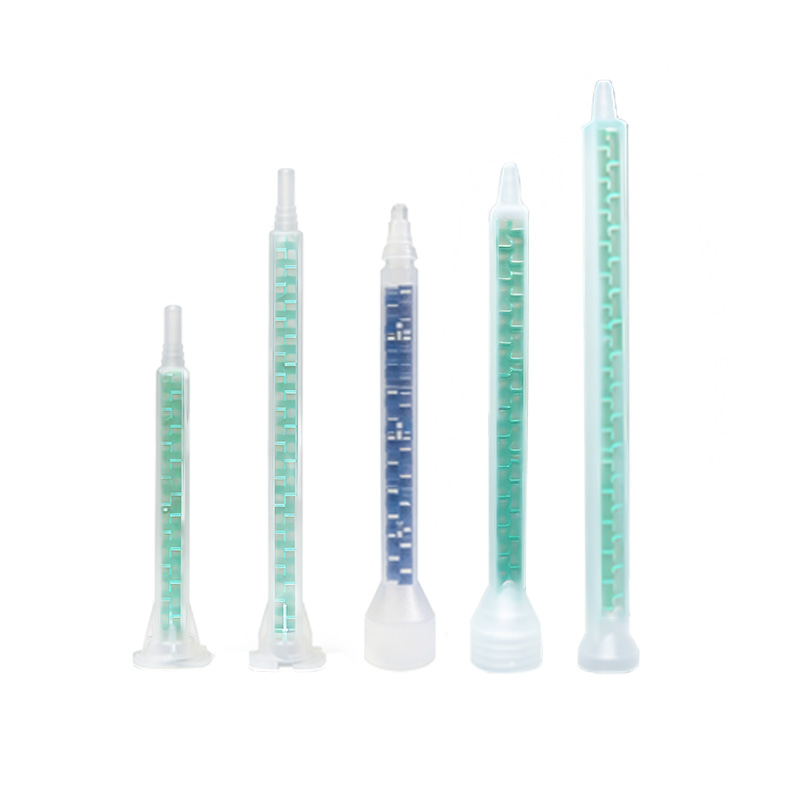
Can you clean epoxy mixing nozzles?The short answer for most situcations is: surface cleaning yes, internal reuse no. Cleaning residue from the outside of a nozzle is a standard step. But cleaning the internal mixing path well enough to reliably reuse it is a different matter.
Once two-component material has entered the mixing elements and begun to react, fully clearing that path is not something that can be confirmed without replacing the nozzle. When mixing consistency and bond quality matter, a fresh nozzle is the more reliable starting point.
What You Can Clean
External residue on the nozzle body, around the tip outlet, and at the inlet connection can be wiped away before it fully cures. Keeping these surfaces clean helps maintain a proper fit when attaching or detaching nozzles from the cartridge, and it is worth doing as a matter of routine housekeeping. These are surface-level tasks. They do not affect the internal mixing path, and they do not raise any reliability concerns.
What You Cannot Clean
The internal mixing channel and the mixing elements inside cannot be cleaned.
The tip outlet interior: If material backs up into the outlet bore, it cannot be reliably removed without altering the orifice diameter or surface finish, which compromises dispense accuracy.
The inlet connection interior: Any residue inside the inlet port (where the nozzle attaches to the cartridge) cannot be accessed for thorough cleaning without scratching or deforming the sealing surfaces, leading to leaks or cross-threading.
Partially cured residue in hard-to-reach crevices: Once beyond the external surface wipe, any residue that has entered micro-gaps, threads (if present), or undercuts is considered permanent contamination.
When to Reuse
Reuse is only possible under a narrow set of conditions:
The nozzle was used for a single, uninterrupted dispensing session with a material that does not cure rapidly at room temperature. The same material is being dispensed again immediately after the first use with no more than a few minutes between stops. Upon visual inspection, the tip outlet, inlet connection, and external surfaces show no cured or partially cured residue. Even then, reuse should be limited to non-critical applications where mix quality can be visually confirmed on each deposit, such as general potting or non-structural fills. In all other cases, particularly when bond strength, cure consistency, or product reliability matters, a fresh nozzle remains the recommended practice.
What Usually Makes Reuse Risky
Cured residue inside the mixing elements: Material that has passed pot life inside the nozzle leaves hardened deposits on the internal surfaces. These deposits narrow the flow path, increase back pressure, and create dead zones where fresh material does not mix properly.
Hidden blockage: Partial curing may not fully block the nozzle but can create flow channels that bypass sections of the mixing geometry. The nozzle appears to function but is no longer mixing completely.
Contamination of the next deposit: Residual cured or partially cured material from a previous use can break off and enter subsequent deposits, introducing inclusions that affect bond quality or cured appearance.
Mix inconsistency: Color streaks, uneven texture, or soft spots in a cured deposit are indicators that the two components were not fully combined. A nozzle that has been reused is a common source of this problem when it appears without other obvious cause.
Increased flow resistance: If the force required to dispense has increased noticeably between sessions, the internal path is partially obstructed. Applying additional force does not resolve incomplete mixing — it only moves partially mixed material through a restricted path.
None of these conditions are reliably detectable without replacing the nozzle and inspecting the deposit quality directly.
When to Replace
Replace the nozzle in any of the following situations:
After an extended work stoppage beyond the material’s pot life, increased back pressure on restart confirms the internal path is no longer clear. When visible cured material is present at the tip or inlet, the internal path condition cannot be confirmed. When flow resistance has increased noticeably during dispensing. When recent deposits show color streaks, soft spots, or uneven cure. For quality-sensitive applications such as structural bonding, electronic potting, or pressure-bearing seals, replacing the nozzle on a defined schedule rather than waiting for visible degradation is the more reliable approach.
What to Do After a Short Pause
For brief interruptions in a dispensing cycle, some operators leave the used nozzle attached to the cartridge as a temporary measure to limit air and moisture exposure at the inlet. This is a common practice rather than a cleaning procedure — the nozzle is acting as a plug, not being prepared for reuse.
When work resumes, the more reliable approach is to remove the used nozzle, attach a fresh one, and dispense a short purge shot before returning to production deposits. This clears any partially reacted material from the inlet zone of the new nozzle and confirms that fully mixed, fresh material is reaching the substrate before the job restarts.
Conclusion: Practical Rule of Thumb for Industrial Users
When it comes to cleaning epoxy mixing nozzles, the rule for industrial users is straightforward: clean the outside, replace the inside. External residue can be wiped away as routine housekeeping, but internal mixing channels and elements should never be considered for regular reuse.
If you cannot confirm with certainty that the internal path is fully clean, discard the nozzle and attach a fresh one. When in doubt, throw it out. A new nozzle costs far less than a failed bond or a rework.
FAQs about Cleaning, Reusing and Replacing Epoxy Mixing Nozzles
Can I soak an epoxy mixing nozzle in solvent to clean the inside?
No. Soaking does not dissolve cured epoxy, and it will not remove hardened residue from internal mixing elements. Solvents may also degrade the nozzle material or leave chemical residue that inhibits proper curing of the next use.
Can I reuse the same nozzle if I only dispense a small amount and stop before the material cures inside?
Only under very limited conditions (same material, short pause, visual confirmation of no residue), and only for non-critical applications. For any work where bond quality or cure consistency matters, replacing the nozzle is the safer choice.
Does cleaning the outside of the nozzle help with reuse?
External cleaning is routine housekeeping to maintain proper fit and handling. It does not affect internal cleanliness and should not be confused with preparing a nozzle for reuse.